Designing Trustworthy Generative AI Self‑Service Systems for Customer Support
Generative AI has become the defining evolution in customer service design — powering self-service systems that can converse fluently, automate resolutions, and streamline escalation. According to recent industry data, 49% of support teams now prioritize generative AI–powered self-service capabilities, with 90% of CX leaders reporting measurable ROI from AI-augmented operations. Yet, another critical number tells a cautionary story: 85% of consumers still prefer human support, even when AI could resolve their issues faster or equally well. The trust gap is clear — and closing it requires more than technology.
For enterprises architecting next-generation support systems, trustworthy AI isn’t merely a compliance checkbox. It’s a design philosophy embedded into every interaction, model, and feedback loop. At Lodgestory, we believe designing responsible, explainable, and human-aligned AI journeys begins with a governance-first approach.
Why Trustworthiness Defines the Future of Generative AI in Support
Generative AI enables unprecedented automation in support operations — resolving complex FAQs, providing contextual responses, and maintaining end-to-end continuity across channels like WhatsApp, Email, and Voice. However, trust determines adoption. Without transparency and calibration, even the most accurate AI can fall short of customer expectations.
In a 2024 survey, 49% of support teams cited the ability to automate complex queries as their top Gen AI driver. However, AI hallucinations, bias propagation, or lack of consent clarity can quickly erode user confidence. Designing trustworthy AI systems thus requires four foundational commitments:
- Transparency — customers must know when they’re interacting with AI.
- Explainability — AI decisions should be interpretable and auditable.
- Accountability — human control and escalation remain available at every step.
- Governance — data usage, feedback loops, and model behavior adhere to enterprise standards.
At Lodgestory, these pillars form the blueprint behind every AI Agent, Bot Journey, and Self‑Service Workflow that we deploy across hospitality, logistics, healthcare, and travel enterprises.
The Trust Calibration Maturity Model: A Framework for Scalable Confidence
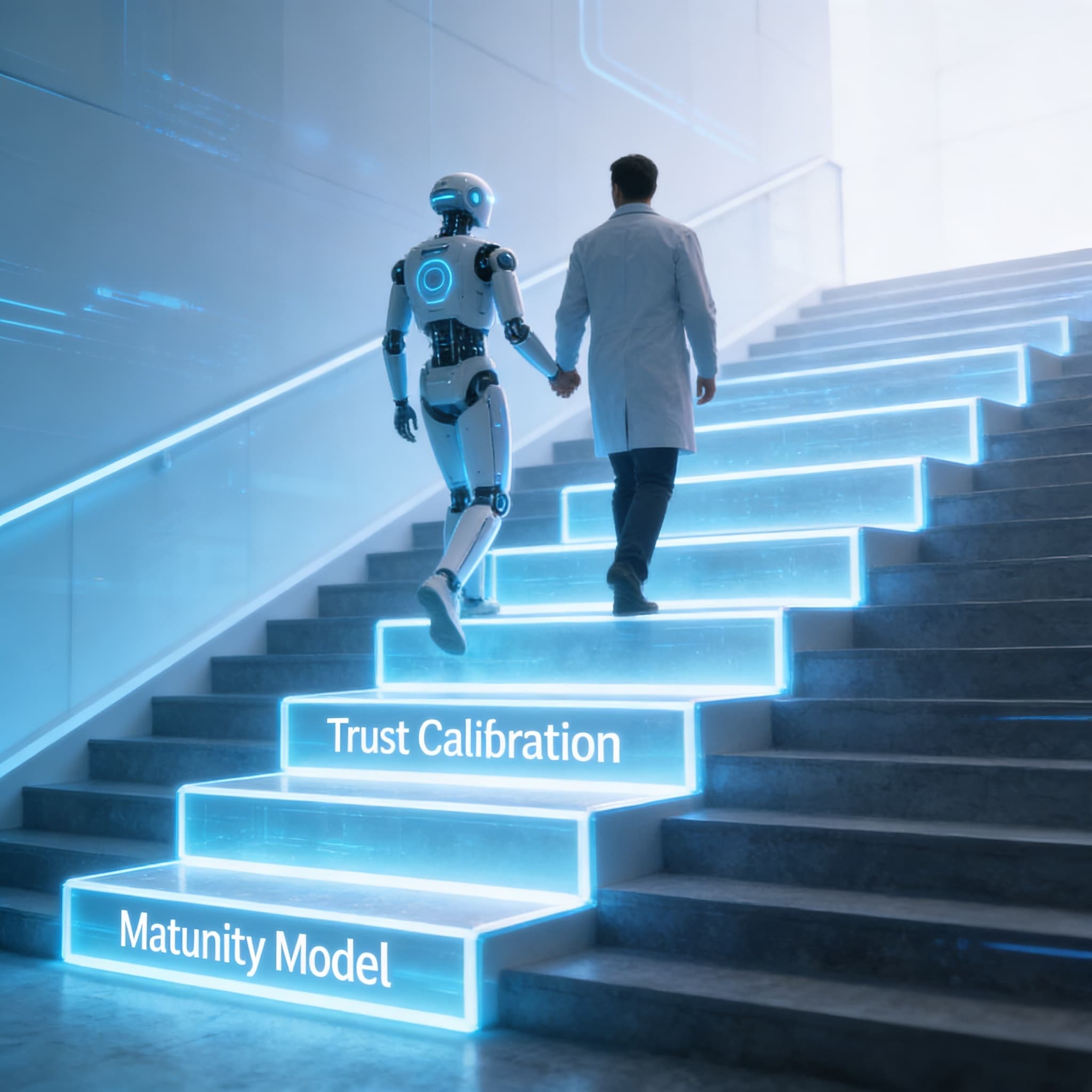
One of the most effective frameworks for designing trustworthy Gen AI systems is the Trust Calibration Maturity Model (TCMM). The TCMM helps enterprises align system capabilities with user trust levels. In essence, trust should scale with transparency, control, and feedback, not just automation.
| TCMM Level | Trust Marker | Design Implication |
|---|---|---|
| Level 1 | Implicit Trust | System is opaque; users unaware of automation |
| Level 2 | Assisted Disclosure | AI introduces itself, basic fallback to human |
| Level 3 | Calibrated Guidance | Explainable results, context tracing enabled |
| Level 4 | Human-AI Collaboration | Continuous learning, trust built via outcomes |
| Level 5 | Trust-Oriented Automation | Full transparency, AI monitored for drift and bias |
In Lodgestory’s deployments, most enterprises start at Level 2–3, combining automated resolution with optional human handovers. With our Bot Journey Builder and AI Agents backed by custom knowledge bases, organizations can gradually progress toward Level 5 automation while maintaining audit trails and model performance reporting through analytics dashboards.
“Trust isn’t inherited from the brand; it’s earned through every automated response.” — Lodgestory AI Studio Team
1. Governance First: Ethical AI Design from Data to Deployment
The most reliable generative systems are governed end-to-end. At Lodgestory, governance begins at the data pipeline level. Every knowledge base, script, or conversational API integrated into Lodgestory’s AI engine undergoes:
- Data lineage verification: ensuring provenance and updates align with privacy standards.
- Bias auditing: monitored across customer intent categories, resolution suggestions, and tone.
- Model traceability: every response is logged with source document references for later audit.
With GPT‑4o‑mini–based reasoning models and vector search over structured knowledge, Lodgestory limits hallucinatory responses by grounding generation in verified enterprise datasets.
For enterprises building ethical AI workflows, Lodgestory provides organization-level governance blueprints — defining access controls, human escalation triggers, logging policies, and SLA-based overrides to keep AI accurate, compliant, and aligned.
2. Explainability: Making AI Reasoning Human-Readable
Generative systems are only as trustworthy as they are interpretable. A customer facing answer such as “I can’t find your booking details” must be explainable — both to the end user and the supervising agent.
Lodgestory’s explainability mechanisms include:
- AI Response Annotations: Each generated answer can display its data source (document, ticket, CRM entry) via tooltips in the unified inbox.
- Traceback Logs: supervisors can replay reasoning sequences to understand why an AI agent suggested a specific outcome.
- Confidence Scores: display probability of correctness, allowing agents to judge reliability before sending.
This layer of transparency helps teams train better models and ensure consistent tone — essential for regulated industries like healthcare or fintech.
For best practices on designing human‑AI workflows, see “Lodgestory: Building the Agentic Enterprise with AI‑Driven Omnichannel Intelligence”.
3. Human Oversight and Escalation Design
While 49% of CX teams now prioritize Gen AI self-service, responsible design recognizes that automation ends where empathy begins. Lodgestory’s omnichannel structure ensures that every autonomous flow has human‑in‑the‑loop checkpoints, such as:
- Agent Transfer Nodes in the Bot Journey Builder for contextual handovers.
- Goal Tracking & Escalation Alerts when AI fails to resolve within thresholds.
- Supervisor Assist Tools allowing human verification before outbound messages.
For example, in hospitality deployment scenarios, if a guest inquiry about a “refund delay” surpasses two automated exchanges without resolution, Lodgestory triggers an SOS ticket to a live agent — ensuring no customer feels trapped in a loop.
This hybrid design always keeps users aware they can “speak to a person,” reinforcing trust and compliance with AI governance best practices.
4. Data Stewardship: Infrastructure for Bias‑Resistant AI
Reliable self-service experiences depend on clean, fair, and well-curated datasets. Bias in training or knowledge ingestion can skew responses, create unfair behavior, or even violate regional AI ethics standards.
Lodgestory’s Knowledge Base Vector Store architecture mitigates this risk by segmenting content per organization, maintaining multi‑tenant isolation, and using semantic normalization across sources. In practice, this ensures that a logistics customer’s bot won’t surface responses meant for a hospitality client, and that vocabulary differences (e.g., “consignment” vs. “order”) are contextually learned.
To enhance fairness:
- Train on diverse, real-world data reflective of customer demographics.
- Establish feedback loops where agents flag misaligned results.
- Use periodic model retraining via Lodgestory AI Studio for contextual adaptation.
5. UX Design for Transparency and Control
Trust also manifests visually and interactively. How AI introduces itself, explains its scope, and provides control options defines customer perception.
Lodgestory recommends the following design patterns:
- Identity Disclosure: Bot explicitly states it is an AI assistant supporting the team.
- Explain Scope: AI mentions what it can and can’t do (e.g., “I can help check booking details, but payment issues go to our support team”).
- Correction Prompts: Actively invite user feedback such as “Did I get this right?” to reinforce learning.
Across WhatsApp, Email, Voice, and web chat — Lodgestory embeds status banners, fallback options, and conversation summaries that make automation feel human, not hidden.
For more perspective on cross-channel design, see “AI Experience Reimagined: How Lodgestory Is Turning Conversations into Actions”.
6. Continuous Trust Monitoring and Ethical Auditing
AI is not a static product; it’s a continuously learning system. Trust must therefore be measured and maintained.
Lodgestory offers real-time AI Reporting Dashboards within its analytics module — tracking:
- AI vs. Human Resolution Rates
- Customer Satisfaction per AI Category
- Escalation Frequency and Trigger Patterns
- Compliance Drift Detection
By connecting dashboard insights with feedback-based retraining schedules, enterprises can identify where their AI is over‑confident or under‑performing.
An example from a logistics customer: after detecting an unusually high “re-explanation” rate (same query repeated), Lodgestory recommended adding disambiguation prompts to the journey builder — improving first‑contact resolution by 24%.
7. Regulatory Readiness: Designing for an AI-Governed Future
Global regulators are converging around AI transparency, data privacy, and accountability. For customer support systems, new frameworks such as the EU AI Act and U.S. Algorithmic Accountability proposals will require explicit disclosure and data audits.
Lodgestory’s AI architecture simplifies compliance through:
- Immutable audit trails for every message, decision, and escalation.
- Role-based access control (RBAC) ensuring only approved supervisors can override AI outcomes.
- Anonymized data exports for external compliance review.
This approach aligns not only with governance frameworks like the Trust Calibration Maturity Model (TCMM) but also with modern enterprise AI responsibility standards.
For more on ensuring compliance across omnichannel operations, see “Bridging the AI Adoption - Integration Gap: How to Build Truly AI-Native Customer Support Operations”.
Case Study Snapshot: AI Self‑Service Done Right
Consider an international hotel chain using Lodgestory’s AI Agents and Visual Journey Builder across WhatsApp and Web chat. After integrating its PMS system and refund workflows, the AI now resolves 72% of inquiries — and guests rate resolution satisfaction 18% higher than before automation. The human handover rate dropped by 40%, while average response time improved by 68%.
The key: transparent disclosure (“I’m an AI assistant here to help with your reservation”), consistent tone, and seamless transfer when customer sentiment indicated frustration.
Lodgestory’s dashboards helped the chain monitor these handovers and retrain journeys monthly, sustaining a trust loop between AI, agent, and guest.
8. Toward the Next Generation of Human‑Trusted AI Systems
As AI evolves from assistant to agent, trust mechanisms will mature further. Future Lodgestory updates will expand multi‑agent orchestration, allowing specialized AI entities (sales, service, analytics) to coordinate under unified ethical controls.
For a detailed look at this paradigm, explore “The Era of Agentic AI: How Multi‑Agent Orchestration Is Redefining Customer Journeys”.
Ultimately, a trustworthy AI self‑service system is not simply one that performs well, but one that:
- Is honest about its nature and purpose.
- Provides control and clarity to users.
- Continuously aligns actions with human values and enterprise ethics.
Conclusion: Building Trust as a Competitive Advantage
Generative AI is no longer a novelty — it’s a frontline necessity. But the future of customer service will depend on trust‑by‑design architectures: systems that respect boundaries, ensure traceability, and grow more reliable through shared learning.
At Lodgestory, this philosophy underpins the AI Agents, Bot Journeys, and Unified Inbox we deliver. By embedding trust, explainability, and human oversight into every component, enterprises can enable AI that customers not only use — but believe in.
Sign up with our Free Forever Plan and start building AI‑driven, trustworthy self‑service journeys that transform support into customer delight.
Related Reading: