The AI Paradox in Customer Support
In 2026, 88% of organizations report using AI in some form, yet only 25% have integrated it into their daily customer support workflows. This 63-point mismatch represents not a lack of technology, but a failure of operational design - a gap between AI adoption and AI integration. At Lodgestory, we define this as the AI Adoption-Integration Gap - the distance between having an AI tool and building a truly AI-native operation.
The difference is profound. Tool-based automation solves surface-level problems - a faster reply, a smarter chatbot, a scripted journey. But AI-native operations transform entire workflows by making AI a core participant in decision making, ticket resolution, and customer experience orchestration.
From Adoption to Integration - Why the Gap Exists
1. Fragmented Knowledge Infrastructure
AI systems can only be as intelligent as the information they can access. In most support environments, knowledge lives across 10+ sources - PDFs, CRMs, help centers, and Slack channels. When AI lacks a unified knowledge base, it produces inconsistent, sometimes inaccurate responses. At Lodgestory, our knowledge base system solves this by powering Retrieval-Augmented Generation (RAG) across all uploaded documents and integrated systems, providing AI agents with a coherent, verified source of truth.
Key takeaway: Integration starts with knowledge unification. Without it, even the best models fail to produce reliable answers.
2. Integration Complexity in Legacy Environments
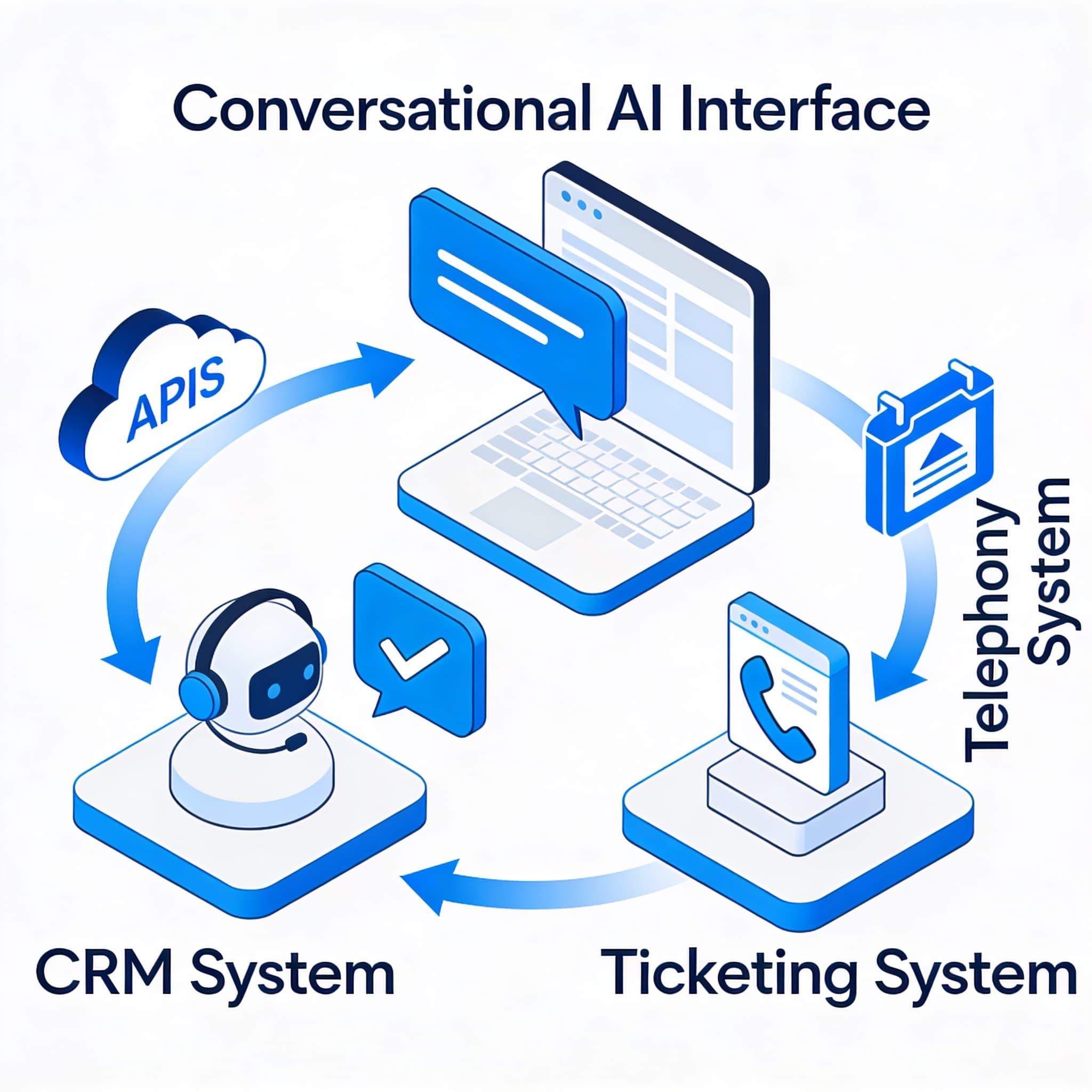
Almost half (48%) of failed AI projects cite integration challenges - not model performance - as the root cause. Most organizations drop AI tools into fragmented environments. Without API access to the CRM, Help Desk, or Voice system, automation stops at the chat stage.
Lodgestory approaches integration differently. Our AI Agents with function calling directly interact with enterprise APIs, executing actions such as booking confirmations, order updates, and refund requests - replacing isolated chat interactions with real-world outcomes.
- CRM access enables dynamic customer lookups
- Ticket automation ensures SLA compliance
- Voice/IVR routing ties conversational agents to telephony
3. Inadequate Escalation Design
Forty-five percent of customers prefer AI-powered support if humans are easy to reach. Yet in 90% of implementations, AI-to-human handoffs fail, causing frustration. At Lodgestory, handoffs are designed early in the process. When confidence scores drop or a user needs escalation, AI transfers context - full conversation, sentiment, and tags - so agents pick up instantly within the unified inbox.
4. Lack of Governance and Risk Controls
Unsupervised AI escalation can introduce real risk in regulated industries. Lodgestory provides AI governance frameworks where organizations define:
- Allowable bot actions (read, update, or restricted)
- Escalation thresholds
- Content sources and compliance policies
This configurable control panel ensures every AI interaction remains safe, compliant, and brand-aligned.
The Framework for AI-Native Customer Support
Transitioning from AI adoption to integration requires deliberate system design. Lodgestory’s methodology organizes this transformation across five stages.
Stage 1: Centralize Knowledge and Data Sources
Start by consolidating all knowledge assets into Lodgestory’s AI Knowledge Base. This provides a clear information architecture for retrieval-augmented reasoning. Connect public FAQs, internal documents, CRM insights, and historical chats.
Example integration flow:
Upload documents → Auto-embed → Connect CRM API → Train knowledge base → Deploy bot journey
Benefits:
- Removes duplication between support and marketing content
- Ensures consistent answers across WhatsApp, Email, and Voice
- Enables long-term AI learning continuity
Stage 2: Orchestrate AI Agents with Real-World Tools
AI without operational execution limits efficiency. Lodgestory’s agents feature tool calling, which bridges conversational intent with business action. For instance:
- A logistics company’s agent invokes the “Track Shipment” API
- A hotel’s AI fetches reservation data and modifies booking
- A clinic’s support bot reschedules appointments via integrated calendar API
This tool-calling framework makes the AI a doer, not a talker - the hallmark of AI-native design.
Learn more about this orchestration in The Era of Agentic AI: How Multi-Agent Orchestration is Redefining Customer Journeys
Stage 3: Embed Automation into the Workflow, Not Next to It
Legacy chatbots often exist as parallel systems - detached from CRM, ticketing, or analytics. Conversely, Lodgestory embeds automation within existing workflows:
- Whenever a WhatsApp query is resolved automatically, it logs in the CRM
- If SLA parameters risk breach, the system escalates in real time
- AI-generated summaries populate into analytics reports
Automation works only when it becomes an inseparable layer of your operational stack.
Stage 4: Design for Hybrid Escalations and Human Supervision
Customer support evolves through cooperation between AI and agents. Lodgestory’s shared inbox allows instant AI-human collaboration, preserving full conversation history and AI-inferred variables. Supervisors can:
- Review AI recommendations in real time
- Intervene and correct AI behavior
- Retrain agents by tagging missteps
Hybrid orchestration ensures fail-fast efficiency without losing empathy.
Stage 5: Track AI Outcomes, Not Just Resolutions
Many organizations measure success by “deflection rate.” Lodgestory encourages outcome-based metrics instead - aligning with how modern leaders like Intercom evolved Fin’s evaluation framework. Each AI interaction is tracked based on business outcome:
- Was the customer’s request fulfilled?
- Did the action trigger a follow-up ticket, campaign, or payment?
- Was the customer satisfaction maintained or improved?
Outcome measurement transforms perception from AI-as-cost-cutter to AI-as-value-creator.
Relevant Reading: AI Experience Reimagined: How Lodgestory Is Turning Conversations into Actions
The Economics of Integration
Organizations that achieve true AI integration report:
- 20-40% automation rates across interactions
- 30-60% lower handling times
- 5-30% higher lifetime value per customer
Compare that to 40% of companies that cancel AI projects before completion due to unclear ROI or rising costs. The difference is not capability - it’s integration maturity.
Businesses using Lodgestory’s AI-native framework consistently outperform because they automate meaningfully, not superficially. For example:
- A travel agency achieved 35% faster response times across WhatsApp and Email by integrating AI agents into CRM workflows
- A medical practice automated appointment rescheduling via WhatsApp campaigns linked to calendar APIs
- A hospitality group uses Lodgestory’s voice IVR for multilingual check-ins, reducing front desk queue congestion by 40%
Avoiding Common AI Integration Pitfalls
- Don’t deploy without knowledge audit - unify all content in one base before launch.
- Define your escalation logic upfront - never let customers repeat steps.
- Prioritize measurable outcomes - track interactions in analytics for ROI proof.
- Empower agents, don’t replace them - let AI remove friction, not human judgment.
- Govern relentlessly - content validations, action permissions, and model guardrails protect your brand integrity.
AI-Native Operations Architecture with Lodgestory
Lodgestory’s architecture integrates every building block needed for AI-native customer support:
- Unified Inbox: Bring WhatsApp, Instagram, Email, SMS, and Voice into one view.
- AI Agents: Automate ticket creation, data retrieval, and voice-based handle-free interactions.
- Bot Journey Builder: No-code visual workflows integrating conditions, APIs, and dynamic variables.
- CRM Automation: Automatically sync AI outputs to contact records and trigger campaigns.
- Voice & IVR Systems: AI-powered call routing and transcribed intelligence integrated with chat workflows.
- Analytics: Performance dashboards measuring resolution outcome, automation efficiency, and agent productivity.
By centralizing communication and automation infrastructure, Lodgestory bridges tool silos into a seamless, intelligent support fabric.
For a detailed breakdown, see Lodgestory Deepens Conversational AI Integration Across Its Omnichannel CX and CRM Suite
AI-Native vs. AI-Augmented: The Architectural Choice
| Attribute | AI-Augmented Support | AI-Native Support |
|---|---|---|
| Design Philosophy | Adds AI to existing tools | Built around AI capabilities |
| Data Model | Structured, form-based | Semantic, vector-based |
| Automation | Partial, triggered by rules | Continuous, based on reasoning and action |
| Escalation | Manual and reactive | Intelligent, context-rich |
| Governance | Optional add-on | Built-in guardrails |
| Customer Experience | Inconsistent | Unified, adaptive |
This architectural choice determines scalability. AI-augmented solutions will continue to plateau at 20-30% automation, while AI-native ecosystems like Lodgestory scale beyond 70% automation with measurable customer satisfaction gains.
The Path Forward
Building AI-native customer support is not merely an IT project - it’s an operational reinvention. Teams that move beyond siloed adoption into structured integration will define the industry standard for responsive, efficient, and empathetic customer experiences.
Every successful implementation shares these traits:
- Centralized, governed knowledge accessible to AI
- Integration-first architecture with open tool APIs
- Measured escalation sequencing that preserves context
- Human-in-the-loop visibility for ongoing refinement
- Outcome-driven analytics measuring value, not just deflection
With Lodgestory, these principles become reality through an extensible omnichannel communication suite and AI orchestration engine.
Transform Operations with Lodgestory
AI doesn’t transform customer support merely by adoption; it transforms through integration - where automation, knowledge, and governance converge. Lodgestory delivers that integration: bridging WhatsApp, Voice, Email, and CRM intelligence into one workspace.
Ready to build an AI-native customer support operation? Sign up with Free Forever Plan and start turning conversations into outcomes today.