B2B vs B2C Customer Support Platforms: Choosing the Right System Architecture for 2026
As customer expectations evolve and AI becomes embedded in support operations, the architectural design of customer support platforms is undergoing a profound shift. By 2026, choosing between B2B and B2C customer support systems is no longer just a matter of pricing or interface—it’s a strategic architecture decision that defines how your organization delivers service, collaborates internally, and measures success.
At Lodgestory, we work with both enterprise-scale B2B organizations and fast-scaling B2C brands, helping them unify channels and automate support through an intelligent architecture designed for each model. Understanding how B2B and B2C customer support differ—technologically, operationally, and strategically—allows teams to choose or design a platform that fits the way they work.
The Business Model Divide That Defines System Architecture
The most fundamental difference between B2B and B2C customer support platforms lies in the relationship model they serve.
B2B: Long-Term Relationships and Multi-Stakeholder Support
B2B organizations manage fewer, higher-value accounts, often involving multiple stakeholders across departments. A single account might represent millions in annual revenue, which means the support architecture must prioritize account-level intelligence over ticket-level isolation. In practice, this translates to:
- Unifying all customer interactions, tickets, and conversations under a single account record.
- Linking support, success, and sales teams through integrated CRMs.
- Emphasizing SLA management, contract alignment, and escalation transparency.
For example, Lodgestory’s CRM and Ticketing system allows organizations to consolidate all email, WhatsApp, or Slack Connect interactions from a given client into one contextual feed—making account-level service seamless.
B2C: Speed, Scale, and Automation
B2C support operates at a completely different scale. Consumer brands often manage tens of thousands of contacts, prioritizing quick resolution and cost control over deep relational context. Here, architecture decisions focus on:
- Automation-first workflows to handle high message volumes.
- Extensive self-service design through chatbots and FAQ systems.
- Advanced analytics to track CSAT, NPS, and agent efficiency.
Lodgestory’s no-code Bot Journey Builder supports both mass-scale B2C automation and contextual B2B interactions, automating up to 70% of inbound queries—without sacrificing personalization.
The Core Architectural Principles of B2B Platforms
1. Account-Centric Data Models
Unlike traditional ticket systems, B2B support architectures use account-focused data models. Each organization becomes a parent record housing all linked contacts, chats, tickets, and contracts.
This architecture:
- Allows teams to view the entire relationship history.
- Simplifies analytics around account health and SLA adherence.
- Powers integrations with CRMs, billing, and monitoring systems.
With Lodgestory, this is native—our Unified Inbox links customer messages from Email, WhatsApp, Instagram, and Voice directly to organizational contacts in the CRM.
2. Business Messaging Integrations (Slack & Teams)
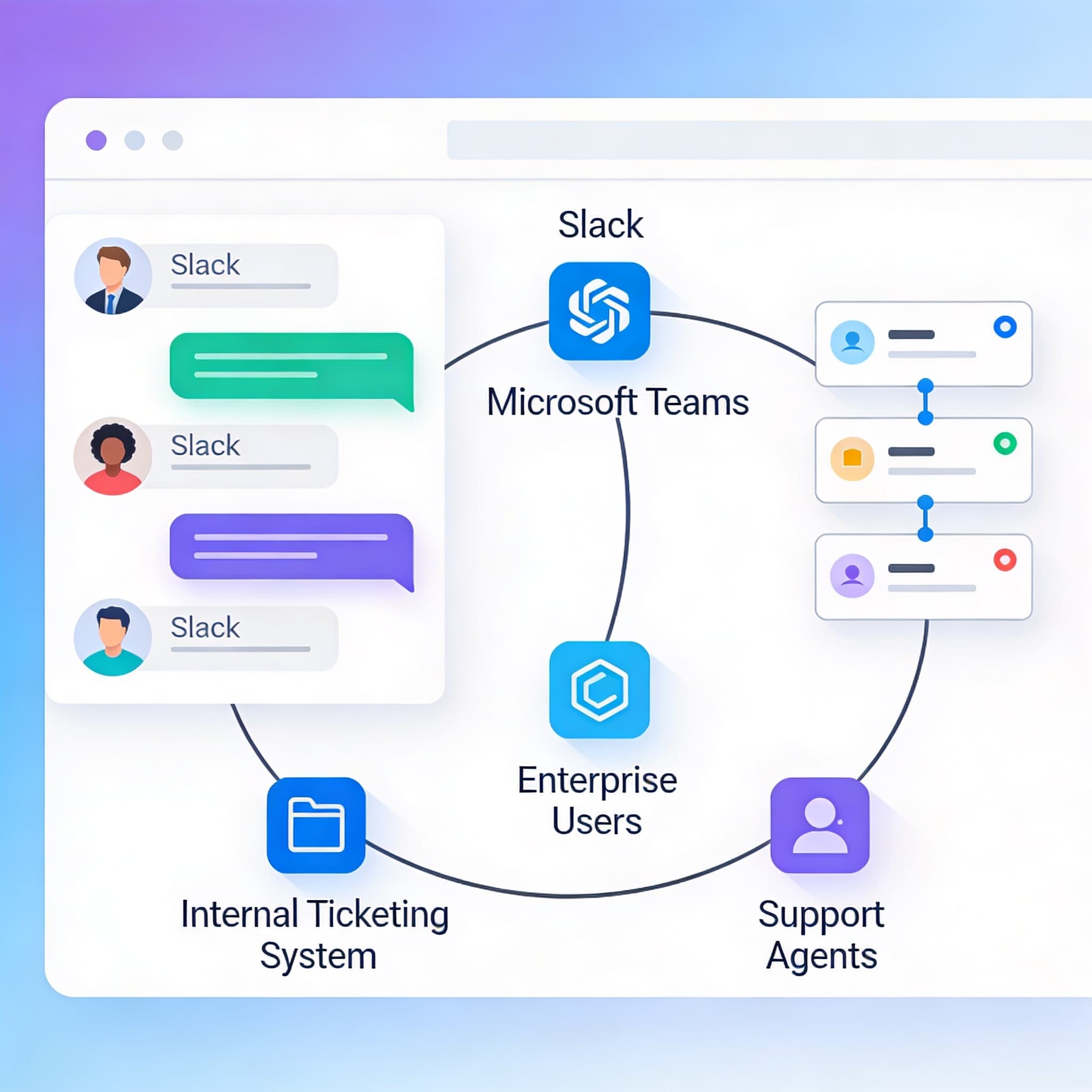
B2B clients increasingly expect to interact through Slack Connect or Microsoft Teams, not just traditional helpdesks. Modern B2B systems embed directly into these collaboration tools.
Organizations integrating support into Slack report up to 60% faster response times and significant ROI. Lodgestory’s Slack integration enables two-way synchronization—agents reply directly within Slack threads, while conversations sync automatically to the ticketing workspace.
3. Intelligent Workflow and Routing Engines
B2B support typically involves multiple departments—technical support, customer success, and account management. Intelligent routing ensures the right person handles the right issue.
Lodgestory’s AI-powered triage system routes tickets and bot events based on conditions like account value, query complexity, and SLA priority. This approach mirrors enterprise-grade intelligent triage, reducing escalation times by up to 40%.
4. Security and Compliance by Design
Enterprise clients demand SOC 2 Type II, GDPR, and ISO 27001 compliance. B2B support systems must enforce role-based access, maintain audit logs, and respect data residency requirements.
Lodgestory’s platform is built for compliance-first deployment, ensuring safe handling of regulated data—vital for industries like healthcare and logistics.
5. Integrated Knowledge Systems
B2B support relies heavily on documentation. AI-powered knowledge systems accelerate agent response by surfacing relevant articles in real time.
Lodgestory’s knowledge base uses OpenAI text-embedding-3-small—empowering AI agents to perform semantic searches across uploaded documents and technical guides. This reduces research time by nearly 46% while enabling smarter customer self-service via bots.
The Core Architectural Principles of B2C Platforms
1. Individual Ticket-Centric Systems
In B2C, the platform architecture treats each conversation or ticket as an independent case rather than part of a longer relationship. Design priorities include:
- Queue velocity (tickets/hour per agent)
- Resolution automation
- Seamless omnichannel continuity
Lodgestory’s Unified Inbox ensures each customer message—via WhatsApp, Instagram DM, or Email—is treated as a single-thread interaction, keeping the response fluid even across channels.
2. Self-Service-Heavy Frontend
According to research, 61% of consumers prefer self-service for basic issues. Modern B2C systems leverage robust knowledge bases, in-chat menus, and AI chatbots to absorb large query volumes.
With Lodgestory’s Bot Journey Builder, brands can deploy intuitive self-service journeys featuring interactive lists, quick replies, and AI-backed free-text input validation—reducing agent touchpoints dramatically.
3. Mobile-First Design
Since most B2C consumers engage via mobile, support systems must ensure instant, responsive experiences. Lodgestory’s omnichannel framework optimizes for mobile performance across WhatsApp, SMS, and social messaging, maintaining sub-second sync times.
4. Customer Sentiment Tracking
Unlike B2B, where satisfaction is measured per account, B2C focuses on aggregate sentiment across thousands of interactions. CSAT and NPS analytics feed directly into campaign strategies.
Lodgestory integrates performance dashboards that track first-response time, resolution rate, and CSAT scores by channel—whether from WhatsApp, Email, or Voice calls.
Workflow and Collaboration: Team Models that Scale
B2B: Multi-Department Collaboration
B2B workflows demand multi-layered coordination. A single ticket may require technical, account, and engineering involvement. The architecture must allow collaborative ticket ownership.
Lodgestory’s ticketing machine supports hierarchical issue categories (e.g., “Integration › API Outage › Severity 1”) and escalation paths with internal notes, ensuring departmental visibility.
Moreover, using the Lodgestory CRM + Ticketing integration, account managers and success teams can coordinate contextual responses—minimizing redundancy and ensuring continuity across long projects.
B2C: High-Throughput Team Workflows
B2C workflows emphasize agent productivity and automation coverage. Agents often work individually, aided by macros, quick replies, and AI auto-responses.
Lodgestory’s AI Agents with Tool Calling execute automated processes (e.g., refund initiation, FAQ answering, order tracking) while escalating exceptions to human agents. This hybrid model allows high throughput without quality trade-offs.
Integration Ecosystems: Aligning the Right Tools
B2B Integration Priorities
- CRM integration: Deep sync with Salesforce or HubSpot ensures that ticket context reflects deal stage and contract value.
- Project management: Linking with Jira or Notion helps track engineering escalations.
- Collaboration: Slack, Teams, or Discord channels for direct customer collaboration.
Lodgestory natively connects to these workspaces while maintaining cross-channel data consistency.
B2C Integration Priorities
- E-commerce and checkout systems: Shopify, WooCommerce, or native storefront APIs.
- Social marketing ecosystems: Meta, Instagram, and Google Ads reconnecting through campaign analytics.
Lodgestory’s e-commerce integration layer even allows product catalog sync, variant management, and messaging-triggered checkouts—expanding support into revenue generation.
Key Architectural Comparison Table
| Feature / Priority | B2B Platforms | B2C Platforms |
|---|---|---|
| Primary Data Model | Account-centric (multi-contact hierarchy) | Individual ticket / customer-centric |
| Collaboration Tools | Slack, Teams, Email Threads | Email, Live Chat, Social DMs |
| Automation Type | Rule-based + AI routing (SLA-aware) | Rule-based + Self-service bots |
| Self-Service Depth | Technical documentation portals | FAQ + Chatbots |
| Security & Compliance | SOC 2, GDPR, HIPAA | GDPR, CCPA |
| Metrics & KPIs | SLA breach rates, account health | CSAT, NPS, first response time |
| Channel Focus | Slack Connect, Email, Voice | WhatsApp, Instagram, Facebook Messenger |
| Scalability Model | Deep integrations, fewer accounts | High ticket volumes, automated escalation |
Choosing the Right Platform for 2026
The choice between a B2B or B2C platform in 2026 boils down to understanding your operational DNA.
If you manage fewer, high-touch clients:
- Favor architectures that emphasize relationship intelligence.
- Invest in platforms with Slack or Teams integrators, account-level SLAs, and powerful CRM synchronizations.
If you serve thousands of consumers:
- Focus on automated workflows, omnichannel live chat, and mobile-first designs.
- Prioritize AI-driven deflection via chatbots and voice assistants.
In both cases, unified communication is becoming non-negotiable. The days of separate email, voice, and chat silos are ending. For insights on how unified platforms are reshaping engagement, check out The Era of Agentic AI: How Multi-Agent Orchestration is Redefining Customer Journeys and 4 Forces Powering the Rise of Voice Commerce.
Lodgestory’s Unified Approach: One Architecture, Infinite Use Cases
At Lodgestory, our omnichannel architecture bridges the B2B and B2C divide under one intelligent system:
- Unified Inbox: Connect WhatsApp, Instagram, Email, SMS, Voice, and IVR in one timeline.
- AI Agents + Knowledge Bases: Deploy intelligent automations backed by contextual data.
- CRM + Ticketing + Campaigns: Manage pipeline, support, and growth operations from a shared workspace.
- Security & Compliance: Enterprise-grade infrastructure across industries.
Whether managing a global hospitality chain or scaling an e-commerce brand, Lodgestory enables teams to respond 40% faster, automate up to 70% of customer inquiries, and grow through personalized, omnichannel interactions.
Ready to align your platform architecture with your business model? Sign up with Lodgestory’s Free Forever Plan today and start automating customer conversations at scale.