The New Imperative: Multilingual Knowledge for a Global Audience
As customer support becomes a defining pillar of brand loyalty, language accessibility is now a non-negotiable expectation. In fact, 75% of consumers are more likely to purchase from a brand that offers support in their native language. For global industries like hospitality, logistics, and healthcare—where boundaries blur and audiences converge—this expectation defines market competitiveness.
Lodgestory enables organizations to meet this moment. As an AI-driven omnichannel CRM, Lodgestory helps businesses build multilingual knowledge bases powered by AI translation, unifying self-service FAQ systems, live agent support, and AI agent interactions across every customer channel and language.
This guide explores how to design, structure, and scale multilingual knowledge bases using Lodgestory’s AI translation and CRM capabilities — ensuring brand consistency, cultural accuracy, and automation-driven scalability across global markets.
Why Multilingual Knowledge Bases Matter More Than Ever
The economic momentum behind multilingual automation is staggering. The AI customer service market will reach $117.87 billion by 2034, growing at a 25.8% CAGR. The reason? AI-driven systems deliver massive cost efficiencies while enabling 24×7 multilingual support.
Consider these contrasts:
- Traditional self-service resolution costs approximately $1.84 per contact.
- Agent-assisted queries cost nearly $13.50 per contact.
- AI-powered resolutions average $1-3 per interaction, delivering a balance of efficiency and effectiveness.
Despite these cost advantages, only 14% of traditional self-service interactions resolve fully, highlighting why the next-generation self-service model—inclusive, multilingual, and AI-powered—is critical to improving both ROI and CX benchmarks.
With Lodgestory, companies can build interconnected knowledge systems that yield 55–70% first-contact resolution rates and average handle times under 3 minutes, empowering AI agents to provide accurate, localized information instantly.
Lodgestory’s Multilingual Knowledge Architecture
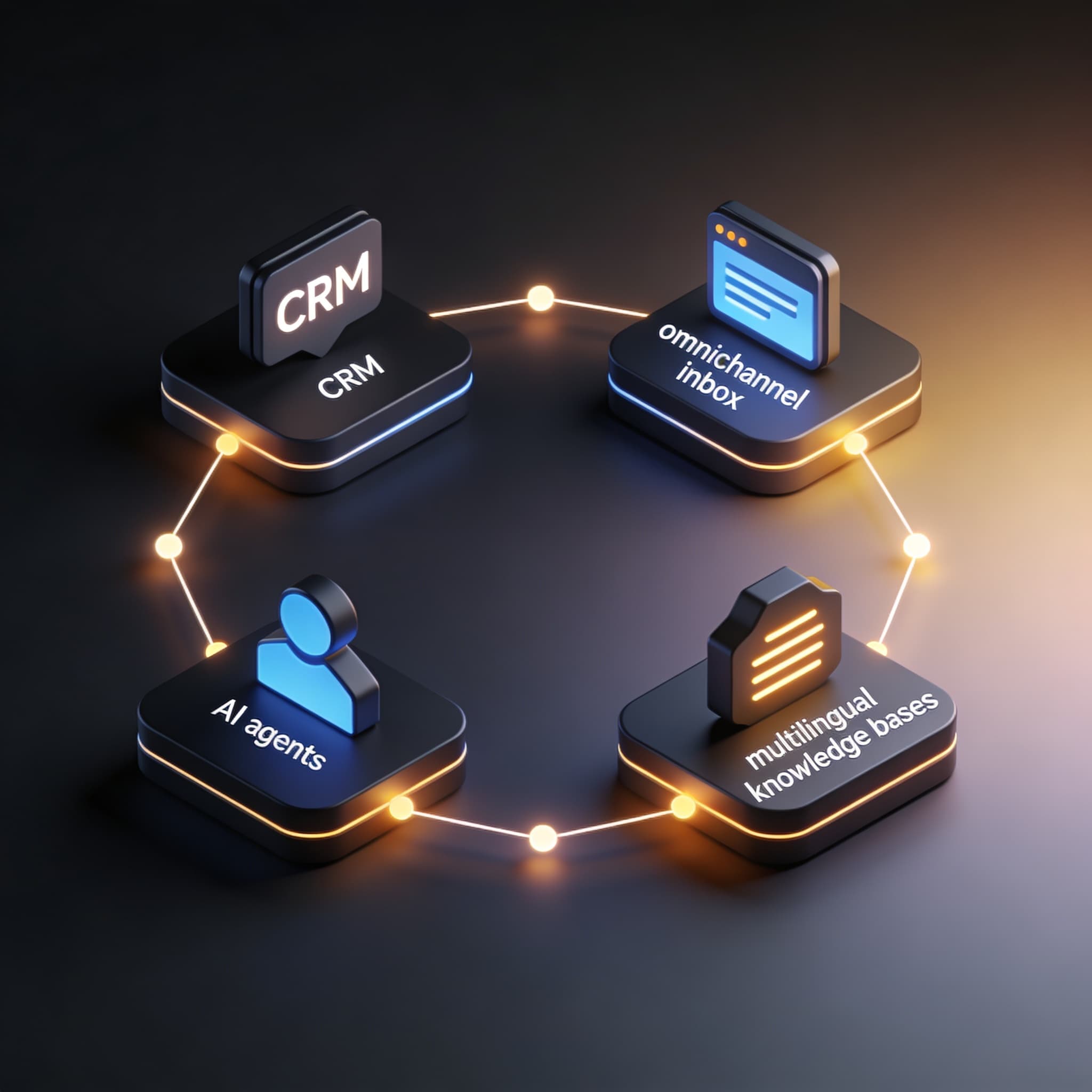
Lodgestory’s unified platform bridges global communication barriers through an integrated approach that connects:
- Multilingual Knowledge Bases — Central repositories for FAQs, guides, and help content in multiple languages.
- AI Agents with Knowledge Context — AI models grounded in vector-embedded knowledge for localized and brand-accurate responses.
- Omnichannel Inbox — Conversations from WhatsApp, Instagram, Messenger, Email, Web Chat, and Voice centralized into one workspace.
- Lodgestory CRM — Contact management with custom fields, multilingual properties, and regional segmentation.
This architecture ensures that regardless of where a guest interacts—a hotel’s WhatsApp bot, a web chat on a logistics portal, or an email reply from support—responses remain contextual, accurate, and aligned with brand tone in every language.
For a deeper dive into Lodgestory’s AI agent architecture, explore “AI Experience Reimagined: How Lodgestory Is Turning Conversations into Actions”.
Designing the Foundation: Language Selection and Demographic Analysis
The foundation of a global knowledge base starts with a clear understanding of audience language needs. Lodgestory CRM enables teams to analyze:
- Chat volume by language – Identify emerging language demands.
- Customer properties – Country, phone locale, or preferred interface language.
- Historical message translation data – Find top markets requesting translated responses.
Use these analytics to prioritize the languages that generate the most value per support interaction.
Once determined, create a “golden” content version (the master reference language), typically in English or the support team’s internal operational language. This master version acts as the authoritative source—ensuring that subsequent translations retain alignment.
Structuring Content for Translation Consistency
When designing a multilingual knowledge base, structural consistency is paramount.
Each article—regardless of language—should maintain:
- Identical headings and order.
- Equivalent warnings, notes, and disclaimers.
- Synchronized media references (images, documents, and videos).
Lodgestory supports article versioning by language, preventing overwrites and preserving independent update cycles. This structure guarantees localization flexibility—allowing a Japanese version of a cancellation policy, for instance, to incorporate region-specific legal disclaimers while maintaining overall informational parity with the master version.
Pro Tip: Use the Lodgestory Content Studio to preview side-by-side article comparisons across languages, ensuring layout and content uniformity.
From Translation to Localization: Getting Cultural Context Right
Lodgestory’s multilingual framework goes beyond literal translation. Localization ensures each article feels written for its audience, not just translated to it. The platform supports glossaries, tone guides, and translation memory—all of which ensure culturally resonant content.
Practical localization approaches include:
- Terminology Management: Define preferred localized terms (e.g., “holiday” vs “vacation”).
- Cultural Adaptation: Use examples, dates, and imagery familiar to the local market.
- Regulatory Compliance: Adapt guidance according to region-specific norms or policies.
With Lodgestory’s AI translation assistant, editors can identify nuances, idiomatic mismatches, or tag errors across versions. The assistant operates through the platform’s embedded OpenRouter AI stack (powered by GPT-4o-mini) with semantic vector retrieval, allowing it to reference contextual facts from the knowledge base to ensure term-level consistency.
Automating Translation and Update Workflows with Lodgestory’s AI
Maintaining multiple versions of an expanding knowledge base manually becomes untenable at scale. Lodgestory automates much of this process:
1. Auto-Translation When Source Articles Update
Whenever a base-language article changes, Lodgestory automatically flags dependent translations for review. Editors can:
- Accept AI-suggested updates powered by translation memory.
- Trigger full article re-translation using the system’s semantic diff engine.
- Assign review workflows to multilingual editors for validation.
2. AI-Aided Review
Using RAG-based AI (Retrieval-Augmented Generation), Lodgestory’s translation layer retrieves prior context, brand tone, and glossary terms before generating new output—ensuring accuracy without compromising style.
3. Synchronization Across Channels
Once published, all FAQ content syncs instantly to:
- WhatsApp Bot Journeys (via quick reply templates)
- Instagram DM responses
- Web Chat widgets
- Voice IVR scripts (auto-converted to audio using text-to-speech)
Empowering AI Agents with Localized Knowledge
Lodgestory’s AI agents leverage multilingual knowledge bases through semantic embeddings, allowing them to:
- Recognize intent in over 100 languages.
- Fetch context-specific facts from localized docs.
- Maintain brand tone consistent with native market expressions.
For example, a French-speaking guest at a resort might ask about “early check-out policy.” The AI agent retrieves the answer from the French version of the hotel’s policy documentation, ensuring accurate communication—without piping the query through round-trip translation that introduces errors.
To see how these AI agents extend beyond translation into full task automation, read “Lodgestory: Building the Agentic Enterprise with AI-Driven Omnichannel Intelligence”.
Managing Changes Over Time
In large organizations, documentation rarely stands still. Lodgestory provides version control per language:
- Version History: trace changes across languages.
- Change Tracking: identify outdated or untranslated sections.
- Audit Logs: ensure quality and accountability across editors.
This alignment ensures business-critical updates like pricing changes, cancellation policies, or compliance messages are always refreshed simultaneously across regions.
Handling Layout and Script Variations
A well-built multilingual knowledge base must accommodate language-specific formatting and layout dynamics:
- Text Expansion: German and Finnish translations often expand article length by 25–35%.
- Right-to-Left Layout: Arabic and Hebrew designs require
direction: rtland mirrored UI. - Low-Resource Languages: Lodgestory supports human review checkpoints for machine-generated translations to maintain trust and clarity.
These considerations become particularly critical in mobile-first contexts, where visual design directly affects readability and conversion.
How Lodgestory Integrates AI Translation into the CRM and Support Ecosystem
Lodgestory unites multilingual knowledge with AI automation through cross-platform integration:
CRM Data Enrichment
Every contact record includes localized fields such as “Preferred Language,” enabling bots and agents to auto-serve FAQs in the same language during contact retrieval.
Ticketing and SLA Management
When tickets are generated in non-primary languages, the Lodgestory platform automatically:
- Detects the incoming language.
- Applies AI translation.
- Links ticket responses back to matching knowledge articles.
Campaigns and Proactive Outreach
Teams can broadcast multilingual campaign messages through WhatsApp, Email, or SMS using localized versions of templates. This ensures customer outreach is equally personalized.
To learn about omni-language messaging at scale, explore “Multilingual Customer Experience at Scale: Building Global Support Systems with AI Translation and Localization”.
Real-World Applications: Hospitality, Logistics, and Healthcare
Hospitality
Hotels and resorts can deploy localized guest FAQs on WhatsApp and websites, covering topics from check-in hours to spa reservations. Multilingual AI agents handle 70% of guest queries, reducing front-desk workload while maintaining service quality.
Logistics
A global logistics firm can unify tracking and delivery FAQs across languages, ensuring that a French consumer and a Japanese retailer read the same policy descriptions—with localized phrasing and measurement units.
Healthcare
Clinics with multilingual patient records can leverage localized FAQs on insurance coverage or appointment policies, dramatically reducing inbound calls while upholding regulatory compliance.
Best Practices for Maintaining a Scalable Multilingual Knowledge Base
- Create a Translation Playbook. Define tone, glossary, and desired terminology up front.
- Leverage Automation but Keep Human Oversight. Machine translations are excellent first passes, but important sections (e.g., legal policies) should be verified by regional experts.
- Schedule Consistency Audits. Quarterly multilingual audits ensure all versions reflect the latest content and branding.
- Integrate Feedback Loops. Use customer feedback tools from Lodgestory CRM to detect inconsistent or confusing translations and correct them in future updates.
Future Trends: From Translation to Native Multilingual Authoring
AI localization is evolving beyond translation. Inspired by Google’s pivot to in-market content creation, Lodgestory plans to introduce in-language authoring assistants, enabling content teams to produce original copy directly in Spanish, Arabic, or Japanese using local semantics.
This shift from translation-as-conversion to localization-as-creation will further enhance brand resonance in international markets.
For more insights into this shift, read “Bridging the AI Adoption – Integration Gap: How to Build Truly AI-Native Customer Support Operations”.
Measurable Outcomes of a Lodgestory Multilingual Strategy
By transforming knowledge bases into intelligent multilingual engines, brands can achieve:
- 70% query automation rate powered by localized AI agents.
- 55–70% first-contact resolution across tier-one inquiries.
- Faster SLA closure times through automated FAQ surface suggestions.
- Higher multilingual engagement and loyalty driven by cultural fluency.
Conclusion: Scale Language, Scale Trust
Global support excellence requires more than translation—it requires unified knowledge, accurate automation, and authentic linguistic empathy. Lodgestory empowers this fusion by giving brands a single system to manage knowledge, automate multilingual conversation, and maintain content consistency across every channel.
→ Sign up with Lodgestory’s Free Forever Plan and start building your AI-driven multilingual knowledge base today.
You might also like: