Voice Commerce is Here—but Trust Hasn’t Caught Up
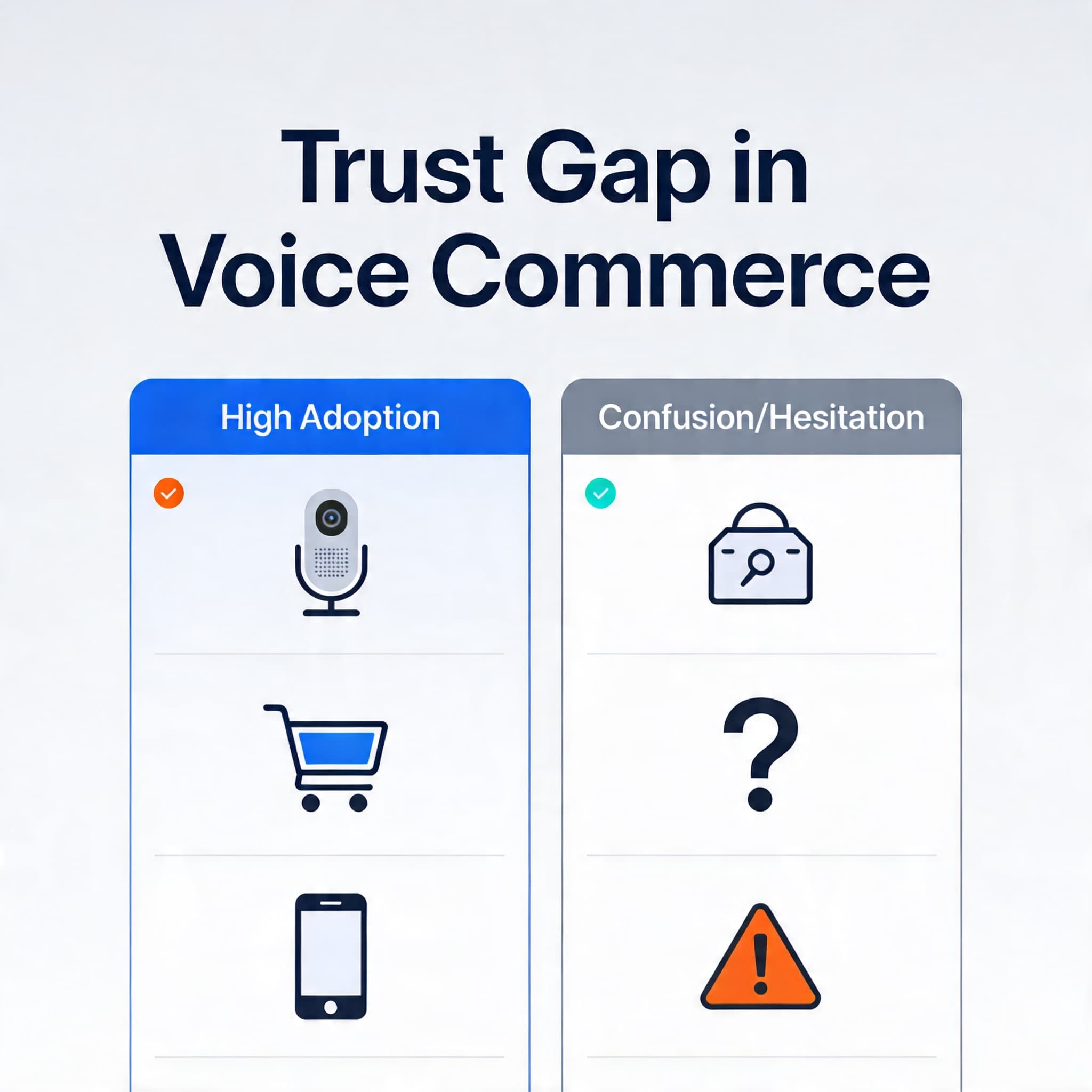
Voice commerce has evolved from a novelty to a serious retail channel. Nearly half of U.S. consumers now use voice assistants for shopping-related activities, and the global market is projected to top $186 billion by 2030, growing at a 24.6% CAGR. Yet despite the adoption curve, consumer trust remains fragile—46% of shoppers don’t trust voice assistants to process orders correctly, and 41% express privacy concerns.
This contradiction defines the trust gap in voice commerce: users are willing to experiment, but hesitant to depend. For voice commerce to become a mainstream purchasing channel, voice interactions must be as reliable, transparent, and explainable as traditional e-commerce experiences.
Lodgestory’s Voice and IVR suite, built on a Signature Technology with WebRTC softphones and intelligent routing, gives retailers and brands the tools to design voice-assisted shopping experiences that don’t just sound human—but act honorable.
In this blog, we’ll unpack the trust architecture behind voice commerce and explore how AI conversation design, powered by Lodgestory’s omnichannel platform, can help retailers build transparent, trustworthy, and revenue-driving voice experiences.
The Voice-Commerce Trust Paradox
Adoption Outpaces Confidence
While 49.6% of consumers use voice to shop and 74% have completed at least one part of the retail buying process via voice, 57% still believe assistants often misunderstand them. The problem isn’t technological capability—but trust consistency.
According to behavioral economists, this reflects the gap between revealed preferences (what we do) and stated preferences (what we believe). Consumers like the convenience of saying “Reorder my groceries” but remain uneasy about data accuracy, system bias, and payment security.
Why Customers Distrust Voice Systems
Common trust blockers include:
- Misinterpretation of intent: Voice systems misclassify queries or commands.
- Opaque recommendations: Assistants present only one product, raising suspicion of commercial bias.
- Lack of confirmation: Orders are executed without confirmation, leading to mistakes.
- Privacy ambiguity: Users fear passive listening or data misuse.
These fears aren’t irrational. A single poor experience—an incorrect order, declined payment, or misunderstood request—can erode confidence permanently.
Design takeaway: Trustworthiness isn’t about sounding human. It’s about delivering predictable, reversible, and transparent interactions that empower users.
Why Trust Is the New Brand Differentiator
When consumers were asked which qualities most increase voice AI trust:
38% cited AI self-disclosure (honesty about being non-human) as the biggest trust driver.
More than accuracy, consistency, or friendliness, users value transparency. Another 55% said they trust systems that confirm understanding before acting.
This means the most trustworthy voice commerce experiences aren’t the ones that hide the AI—they’re the ones that explain their limits and keep the user in control.
From Voice to Trust: The Lodgestory Design Framework
Lodgestory helps businesses turn these behavioral insights into tangible experiences through AI-driven conversation design layered with voice and IVR workflows that are transparent by default.
1. Design for Confirmation Before Action
Retailers using Lodgestory’s visual Bot Journey Builder can insert confirmation nodes before sensitive operations. For example:
User: “Order three packs of almonds.”
Assistant: “Just to confirm — three 250g packs of Blue Diamond almonds to your saved address?”
User: “Yes.”
This pattern—"acknowledge → confirm → act"—dramatically reduces perceived error risk while increasing cognitive trust.
Lodgestory’s conditional branching and AI validation nodes ensure that these confirmations are contextually aware and dynamic, adapting phrasing based on prior dialogue or cart contents.
2. Make AI Intent Visible
Users lose trust when they don’t know how or why a system chose a particular result. Lodgestory’s AI Agent framework uses explainable conversation logic to make decisions transparent:
- Agents can state their reasoning (“I found this because it matches your previous coffee order”).
- They can invoke organization-defined custom APIs to fetch recommendations and display sourcing context.
- They can provide multiple choices in quick-reply format to avoid perceived bias.
This reduces the biased offer perception by exposing more control to the user.
3. Design Graceful Error Recovery
Voice systems inevitably fail. What matters is how they fail. Lodgestory enables AI agents to trigger goal tracking and agent transfer events when confidence thresholds drop below safe levels:
“I’m having trouble matching that product. Would you like me to connect you with an assistant?”
Since 75% of users say they’ll retry after an AI error, creating positive recovery experiences is more important than eliminating every potential failure.
With Lodgestory’s WebRTC softphone integration, human agents can join the call in seconds, delivering a hybrid voice-AI experience that clients perceive as handoff—not failure.
4. Inject Transparency into Voice Workflows
Lodgestory’s IVR flow designer lets brands introduce transparency features like:
- “This interaction uses AI to understand your voice requests.”
- “You can request a human representative anytime.”
- “Your responses are used to improve service; they aren’t shared externally.”
These disclosures, while brief, measurably increase AI self-disclosure trust metrics and can be implemented as standard “pre-intent” prompts across all inbound calls.
5. Leverage Multimodal Reinforcement
Voice commerce doesn’t have to be voice-only. Lodgestory’s Omnichannel Inbox unifies voice, WhatsApp, Instagram, SMS, and email, so the same bot or agent can confirm or summarize transactions through another channel.
For example, after a voice purchase:
“I’ve confirmed your order. You’ll receive the invoice on WhatsApp.”
This connection between voice interaction and visible confirmation resolves the psychological need for tangible proof—a key trust accelerator.
Technical Precision = Trust Precision
Lodgestory’s technical ecosystem is engineered to eliminate ambiguity, the biggest enemy of trust.
Sub-5% Word Error Rates with Contextual Routing
By combining multi-accent ASR models and contextual prefill from CRM properties, Lodgestory minimizes misinterpretation risks even in multilingual environments. For high-stakes categories like pharmaceuticals or financial products, this difference can make or break user confidence.
Intent-Aware AI Agents
Each Lodgestory AI agent employs tool-calling logic and multi-turn reasoning to refine intent before taking action. This architecture allows the AI to:
- Perform real-time variable extraction from prior conversations.
- Call custom APIs (e.g., inventory check, payment authorization) before responding.
- Exit to specific fallback journeys if low-confidence detections occur.
This level of orchestration transforms reliability into a design feature, not a statistical outcome.
Actionable Design Principles for Retailers
Building trust-based voice commerce isn’t a creative experiment—it’s a systematic design process. Here’s how to apply these principles practically using Lodgestory:
| Trust Principle | Conversation Design Technique | Lodgestory Feature |
|---|---|---|
| Confirm understanding | Rephrase with confirmation prompts before actions | Bot Journey confirmation nodes |
| Transparency | Self-disclosure and reasoning statements | Custom IVR scripting & AI output templating |
| Error resilience | Offer retry or human escalation immediately | Agent Transfer & SLA-tracked ticket creation |
| Explainable choices | Provide multiple product options | Interactive quick replies & list menus |
| Proof consistency | Send summaries post-interaction | Cross-channel automation via Unified Inbox |
Each of these elements can be created without writing a single line of code through Lodgestory’s no-code visual builder.
The Generational Factor: Designing for Digital Skeptics
Contrary to expectation, Gen Z shoppers, while the most tech-native, report the least trust in AI systems—only 46% express comfort with AI interactions. They’re also more likely than any other group to fake satisfaction during AI interactions just to end them quickly.
This data shows that transparency and agency—not hype—build loyalty among younger consumers. Retailers can apply this by:
- Allowing opt-in human handover directly within IVR journeys.
- Providing visibility into order modification or cancellation commands.
- Offering omnichannel continuity—linking the voice flow to WhatsApp or Instagram for clarity.
Lodgestory’s shared inbox model makes this seamless: every conversation continues across channels, preserving context through variable interpolation across systems.
Integrating Voice Commerce into Omnichannel Retail
Voice commerce should never exist in isolation. With Lodgestory, voice becomes another access layer in your broader omnichannel retail design.
For example:
- A customer initiates a voice order through an IVR.
- The AI agent confirms details and sends a WhatsApp summary using a pre-approved message template.
- The message includes an inline Razorpay payment link managed directly through Lodgestory’s e-commerce module.
- Receipts and follow-ups are tracked in the same customer thread logged under CRM.
This approach merges convenience, visibility, and continuity—reinforcing trust across touchpoints. See our related post on The Top WhatsApp Marketing Features in 2026: What Businesses Can Do with Lodgestory to explore how these channels complement voice-enabled retail.
Measuring the ROI of Trusted Voice Commerce
Trust isn’t just ethical—it’s measurable. Retailers using AI agents for conversational commerce have seen:
- 12–23% conversion rate increases.
- 35% recovery of abandoned carts.
- 25% higher average order values when customers engage with conversational assistants.
Using Lodgestory’s Analytics Suite, businesses can attribute these results to conversation performance, intent match rates, and follow-through outcomes. Transparency becomes not just a UX policy—but a data-driven growth strategy.
For deeper insight into how conversational ROI is calculated across channels, read Measuring the ROI of WhatsApp Business Messaging in 2026: Analytics, Attribution, and Performance Tracking.
The Future of Voice Commerce: From Transactional to Consultative
As the technology matures, AI voice interactions will evolve beyond “buy” commands into full consultative shopping—helping users compare features, read reviews, or cross-check product bundles.
To deliver this future, conversation design must:
- Handle multi-turn clarification seamlessly.
- Exhibit memory persistence across channels and sessions.
- Reference a knowledge base for product data and policies.
Lodgestory’s AI Agents with Knowledge Bases enable just this—using RAG-based semantic search to answer nuanced queries like, “Which air purifier is best for small apartments with pets?” thereby transforming voice commerce into a guided expert experience.
Conclusion: Designing for Trust, Not Novelty
The success of voice commerce won’t be determined by who builds the most human-sounding assistant. It will be determined by who builds the most trustworthy one.
Retailers adopting Lodgestory’s voice, IVR, and AI conversation capabilities can bridge the trust gap by designing clarity into every interaction. From confirmation prompts and transparent automation to multimodal reinforcement and SLA-managed escalation, Lodgestory transforms voice interactions from risky experiments into loyal customer touchpoints.
Ready to build voice commerce experiences your customers actually trust? Sign up with our Free Forever Plan and begin designing transparent, AI-powered voice journeys today.
For a deeper dive into the technological forces shaping the category, read 4 Forces Powering the Rise of Voice Commerce: How AI, Omnichannel Design, and Customer Behavior Are Shaping the Future.