What Is Abandonment Rate and How Lodgestory Helps Businesses Reduce It
Abandonment rate represents one of the most revealing metrics in customer experience management — the percentage of customer interactions or processes that are initiated but never completed. Whether it’s a call dropped before an agent responds, a WhatsApp chat that ends mid-conversation, or an eCommerce cart left unpurchased, each abandonment signals a point of friction in the customer journey.
Understanding the Abandonment Rate in Omnichannel Context
In traditional contact centers, abandonment rate measures the share of incoming calls that customers end before speaking to a representative. Globally, contact centers experience abandonment rates averaging 5–8%, with elite performers achieving under 3%. In eCommerce, cart abandonment averages a striking 70%, meaning seven out of ten shoppers leave before checkout completion.
For businesses in hospitality, logistics, healthcare, and retail — the sectors Lodgestory serves most — each percentage point of abandonment equates to lost revenue and customer trust. For instance, a hospitality call center handling 2,000 inbound calls per day with a 7% abandonment rate could lose thousands in missed bookings or upsells. Similarly, high checkout abandonment in travel or retail can erode margins even with steady site traffic.
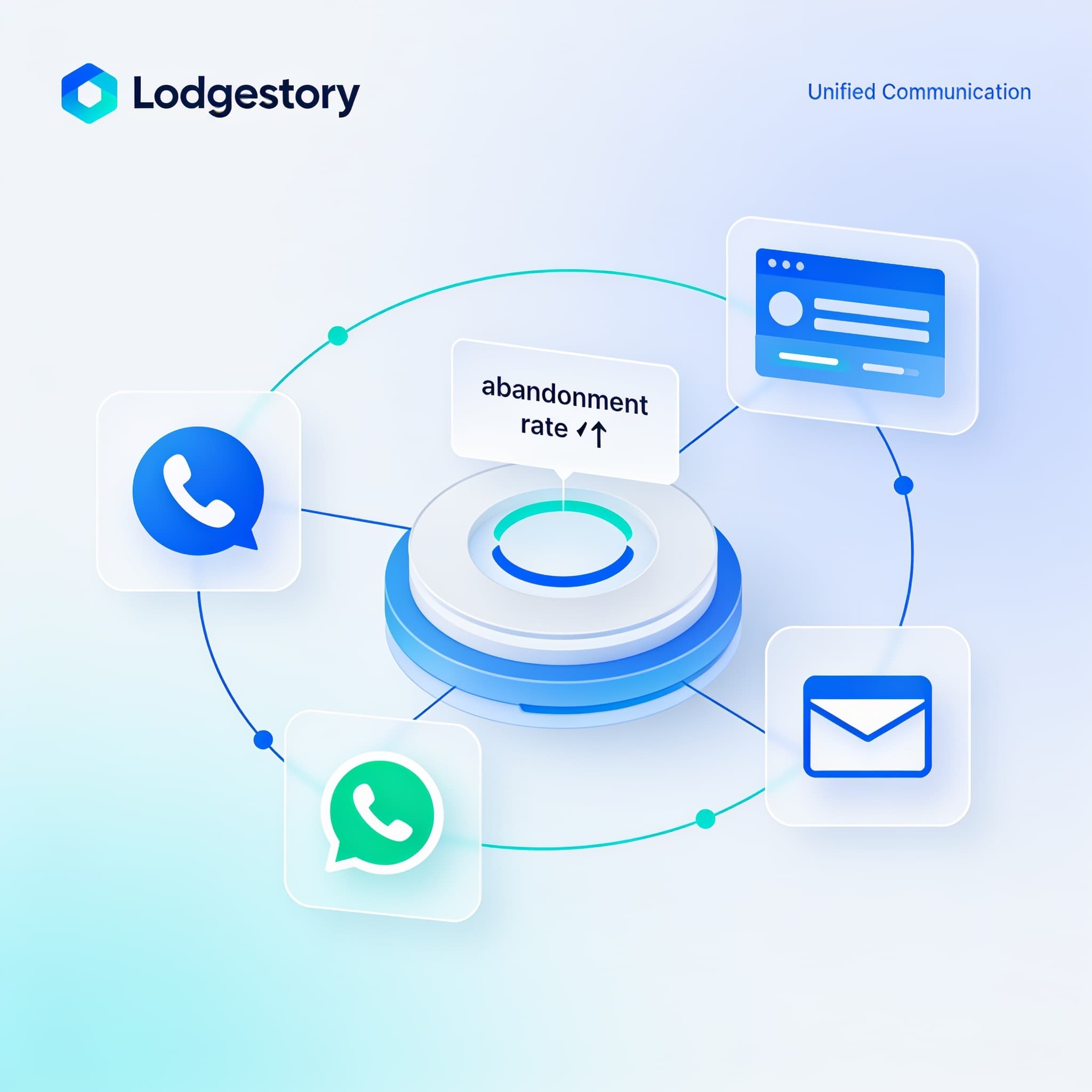
At Lodgestory, we view abandonment not just as a KPI, but as a real-time signal of friction, mismanaged expectations, or operational inefficiency across communication channels. By integrating Voice, WhatsApp, Instagram, Email, and Web chat into a single omnichannel workspace, Lodgestory allows businesses to track, understand, and minimize abandonment holistically — rather than managing it in silos.
Root Causes of High Abandonment
High abandonment rates usually arise from operational bottlenecks, design issues, or experience misalignment. Common causes include:
In Contact Centers:
- Long or inconsistent wait times caused by peak-hour overloads.
- Confusing IVR menus that frustrate or misdirect callers.
- Poor automatic call distribution (ACD) or lack of call-back workflows.
- Voice disconnections during transfers or routing errors.
In Digital Channels:
- Slow or unpersonalized chat responses.
- Lack of real-time agent availability indicators.
- Complex checkout processes or unclear pricing.
- Irrelevant automated responses due to limited bot training.
Each of these points can be measured and acted upon through Lodgestory’s unified analytics and AI event tracking, enabling teams to identify abandonment moments instantly and intervene effectively.
How Lodgestory Reduces Abandonment Rate
Reducing abandonment requires both automation and empathy — two principles embedded in Lodgestory’s platform design. Here are practical strategies businesses use within Lodgestory to cut abandonment substantially:
1. Reduce Wait Times With Smart Routing
Lodgestory’s Automatic Call Distribution (ACD) and Voice/IVR routing engine ensure callers quickly reach the right team based on intent, priority, or department. With real-time queue monitoring and intelligent fallback paths, businesses can drop abandonment rates below 4% even during traffic spikes.
Learn how adaptive routing improves efficiency in How Lodgestory’s Automatic Call Distribution Makes Voice Support Smarter, Faster, and More Human.
2. Offer Virtual Queues and Callbacks
Rather than forcing callers to wait on hold, businesses using Lodgestory Voice can trigger a callback promise — keeping the customer’s position in queue while letting them go about their day. This feature alone can reduce abandonment by 20–30% in service-heavy environments like healthcare and hospitality.
3. Empower Customers With Self-Service Bots
Lodgestory’s Bot Journey Builder allows brands to deploy no-code, omnichannel bots that resolve up to 70% of routine queries. From booking confirmations to order tracking, these bots can engage customers 24/7 across WhatsApp, Instagram, web, and voice. If a customer finds their answer in-chat, that “abandonment” becomes a good abandon — a resolved issue without human intervention.
For deeper personalization, AI Agents connected to custom knowledge bases can summarize FAQs or dynamically hand off conversations when intent complexity increases.
Explore how AI-driven self-service can boost CX in AI Experience Reimagined: How Lodgestory Is Turning Conversations into Actions.
4. Provide Real-Time ETAs and Transparency
Customers are far less likely to drop off when they know what to expect. Lodgestory lets support teams surface estimated response times directly in chat or IVR flows. With configurable service-level agreements (SLAs), customers are informed about their queue position and resolution timelines — reducing perceived waiting frustration.
5. Integrate Multichannel Continuity
Customers frequently abandon support interactions when switching channels. With Lodgestory’s unified inbox, agents can resume a conversation across WhatsApp, Email, or Voice without losing context. A customer who drops a chat on Instagram can continue the same thread on WhatsApp seamlessly. This connected experience cannot be achieved in siloed systems.
Related reading: Multilingual Customer Experience at Scale: Building Global Support Systems with AI Translation and Localization
6. Chat Widgets and Smart Engagement on Websites
Lodgestory’s new Chat Web Widget can be embedded in any site — including Shopify, Next.js, or WordPress — enabling businesses to redirect website visitors into conversational flows before they bounce. Pairing the widget with Lodgestory’s WhatsApp campaigns or AI-driven follow-ups can reclaim up to 15% of previously lost high-intent leads in eCommerce.
See how conversational commerce drives conversions in Voice Commerce on Shopify: The Next Frontier for Conversational AI in eCommerce.
Measuring and Refining Abandonment Metrics in Lodgestory
Lodgestory’s analytics suite tracks abandonment across calls, chats, emails, and web interactions in one place. Businesses can segment metrics by:
- Channel (Voice, WhatsApp, Instagram, Email, Web)
- Ticket category or department
- Bot vs. Agent engagement
- Time to first response (TFR)
With downloadable reports and SLA-linked tracking, managers can isolate where — and why — customers exit prematurely. Over time, pattern recognition powered by AI highlights friction points that predict abandonment spikes.
For example, a logistics firm might notice a surge in chat drop-offs when delivery tracking information isn’t automatically updated. By integrating the Lodgestory API into its backend system, it can auto-notify customers of status changes — reducing drop-offs and inbound queries by over 35%.
The Bigger Picture: Turning Abandonments Into Insights
Modern CX leaders treat abandonment as a diagnostic indicator, not just a failure metric. Lodgestory helps teams analyze which abandons imply frustration (“bad abandons”) and which represent successful automation (“good abandons”). This nuanced reporting ensures your KPIs actually reflect customer satisfaction, not just volume reduction.
By combining AI analytics, journey tracking, and multi-channel orchestration, Lodgestory turns abandonment data into actionable insight — improving response times, employee efficiency, and ROI.
Reimagine your customer journey today. Sign up with Free Forever Plan and start reducing your abandonment rate with AI‑driven automation.