Introduction
The evolution of customer support software in 2026 is defined by one critical shift: the transition from ticketing-centric systems to AI-native, omnichannel platforms designed for real-time, autonomous resolution. Zendesk, long the category leader, now faces mounting pressure as businesses demand higher automation rates, integrated communication channels, and more affordable pricing models. As companies reevaluate their service infrastructure, the search for the best Zendesk alternatives has never been more intense.
In this comprehensive guide, we explore how the support software market has transformed in 2026, analyze leading competitors in each category, and show how Lodgestory — an omnichannel, AI-driven customer communication platform — redefines what modern businesses expect from their customer engagement stack.
Why Businesses Are Moving Beyond Zendesk in 2026
According to G2’s 2025 data, Zendesk continues to lead in market share among helpdesk platforms. Yet under the surface, the industry is shifting toward AI-driven resolution performance, not ticket volume. New AI-native competitors boast 55–85% first-contact resolution (FCR) rates — compared to the 10–25% typically achieved by legacy chatbots.
This evolution reflects a redefinition of value in customer service:
- Resolution-centric metrics now outperform traditional measures of response time.
- AI autonomy (executing tasks end-to-end) matters more than ticket deflection.
- Omnichannel unification (managing WhatsApp, Instagram, Email, SMS, and Voice) is non-negotiable for modern teams.
Businesses no longer ask, “How fast did we respond?” They now ask, “How often did we resolve an issue without human intervention?”
In parallel, cost structures are being overhauled. Zendesk’s hybrid model ($1.50–2.00 per AI resolution on top of per-seat licensing) contrasts sharply with outcome-based AI-first competitors like Intercom Fin ($0.99 per resolution) — and with Lodgestory’s Free Forever plan offering a low-barrier way to start scaling AI and omnichannel support.
1. Traditional Helpdesk Alternatives
Freshdesk: Familiar Experience, Lower Cost
Freshdesk mirrors Zendesk’s core functions — ticketing, SLAs, and team automations — at 30–40% lower price points. Its clean UI, free entry tier, and native integrations (Freshsales, Freshchat) make it appealing to SMBs. However, its architectural design lacks unified thread views. Agents must switch between tabs for different channels, resulting in context fragmentation and lower agent productivity over time.
Pricing Snapshot: Free for 3 agents; paid tiers from $15 to $79 per agent/month.
While Freshdesk’s “Freddy AI” supports summarization and auto-routing, it lacks advanced autonomous workflow execution — making it a lower-cost but non-AI-native option.
Help Scout: Simplicity Over Complexity
Help Scout thrives among startups valuing simplicity over scale. Priced between $22 and $65 per seat, it offers collaborative email, chat, and a knowledge base interface that’s intuitive for small teams. But it lacks features like SLAs, voice integration, and extensive automation.
If your support strategy prioritizes fast onboarding and minimalism, it works. But it hits capacity ceilings quickly for mid-sized service organizations.
Zoho Desk: A Budget Omnichannel Entrant
Part of the Zoho ecosystem, Zoho Desk integrates naturally with Zoho CRM and Books. With pricing starting at $14 per seat, it’s a viable low-cost omnichannel option for teams already embedded in Zoho’s suite. Its AI assistant Zia adds conversational and intent-detection features, but lacks the resolution intelligence of next-generation AI helpdesks.
LiveAgent: Voice at a Value
LiveAgent differentiates itself by bundling voice, chat, and ticketing with native VoIP integration at cost-effective rates. It claims up to 75% conversation automation, although “automation” here typically means responses from templates, not true AI orchestration. The platform is ideal for budget-conscious BPOs but falls short in AI depth and advanced analytics.
Key takeaway: Traditional alternatives like Freshdesk and Help Scout remain ideal for smaller businesses prioritizing affordability and ease of setup — not organizations seeking advanced AI or unified omnichannel experiences.
2. All-in-One CX Platforms
Salesforce Service Cloud: The Enterprise Titan
Salesforce remains the enterprise benchmark for integrated CX, linking support with CRM, marketing, and commerce data streams. Its Einstein AI powers predictive routing and case insights, and integration capabilities are unmatched. However, at $550 per user/month, it’s reserved for large-scale operations with existing Salesforce infrastructure.
Strengths:
- Enterprise-grade automation with CRM visibility.
- Deep ecosystem integrations.
- Predictive support insights via Einstein AI.
Constraints:
- High implementation cost and long onboarding cycles.
- Overkill for SMBs or companies seeking flexible, AI-native solutions.
HubSpot Service Hub: Unified Context for Growing Teams
HubSpot excels in blending marketing, sales, and support into one platform. Starting at $20/seat, it provides contextual support visibility — linking every ticket to a customer’s purchase and campaign history. It’s best suited for mid-market SaaS and growth-stage brands prioritizing integrated lifecycle management.
HubSpot’s AI capabilities (auto-routing and assistive replies) are opinionated but not autonomous. Thus it falls under the “AI-supported” category rather than “AI-native.”
Intercom: Bet on Generative AI
Intercom pivoted heavily toward AI with its Fin agent, launched in 2025. Fin’s 50%+ containment rate and transparent per-resolution pricing make it one of the most commercially viable Zendesk competitors. The platform’s strength lies in in-app messaging, contextual user journeys, and developer extensibility.
However, limitations arise with voice and multi-system orchestration, leaving an opening for more holistic omnichannel solutions — a space Lodgestory purpose-built to command.
Pricing Snapshot: Fin AI at $0.99 per automated resolution + per-seat fees.
Who it’s for: Product-led SaaS and digital-first brands needing sophisticated in-app automation but without legacy telephony dependence.
3. AI-Native Resolution Platforms: The Next Frontier
The most disruptive entrants in the Zendesk alternatives landscape aren’t traditional ticketing competitors — they’re AI-native resolution platforms designed to eliminate tickets altogether.
Platforms like Lorikeet, Ada, and Forethought usher in the agentic AI era, where bots not only converse naturally but also execute actions — issuing refunds, updating customer profiles, rescheduling deliveries, and verifying identity independently.
Lorikeet: Full Workflow Automation
Lorikeet connects directly to backend systems — CRMs, billing tools, order management — and autonomously performs user requests. It reports 55–70% first-contact autonomous resolution, dramatically outperforming typical chatbot frameworks. Rather than route tickets, Lorikeet closes them.
Ada: Multimodal AI Assistance
Ada’s reasoning engine layers multiple LLMs (OpenAI, Anthropic, Azure) with logic orchestration, providing multilingual and multimodal coverage (chat, email, voice). Case studies report 70–84% resolution, though realistic operational benchmarks hover around 40–50%.
Forethought: AI Assistant Layer for Legacy Platforms
Forethought’s Solve and Triage modules integrate directly into existing Zendesk and Salesforce setups, boosting automation without migration. This appeals to large incumbents seeking incremental AI without full-stack replacement.
The takeaway: These AI-native platforms demonstrate how support’s center of gravity is shifting — from reactive management to proactive, system-integrated resolution.
4. Lodgestory: Unified, AI-Driven, and Built for the Omnichannel Era
While established players enhance isolated features, Lodgestory reimagines customer support from the ground up.
Built for hospitality, logistics, travel, and healthcare, Lodgestory fuses:
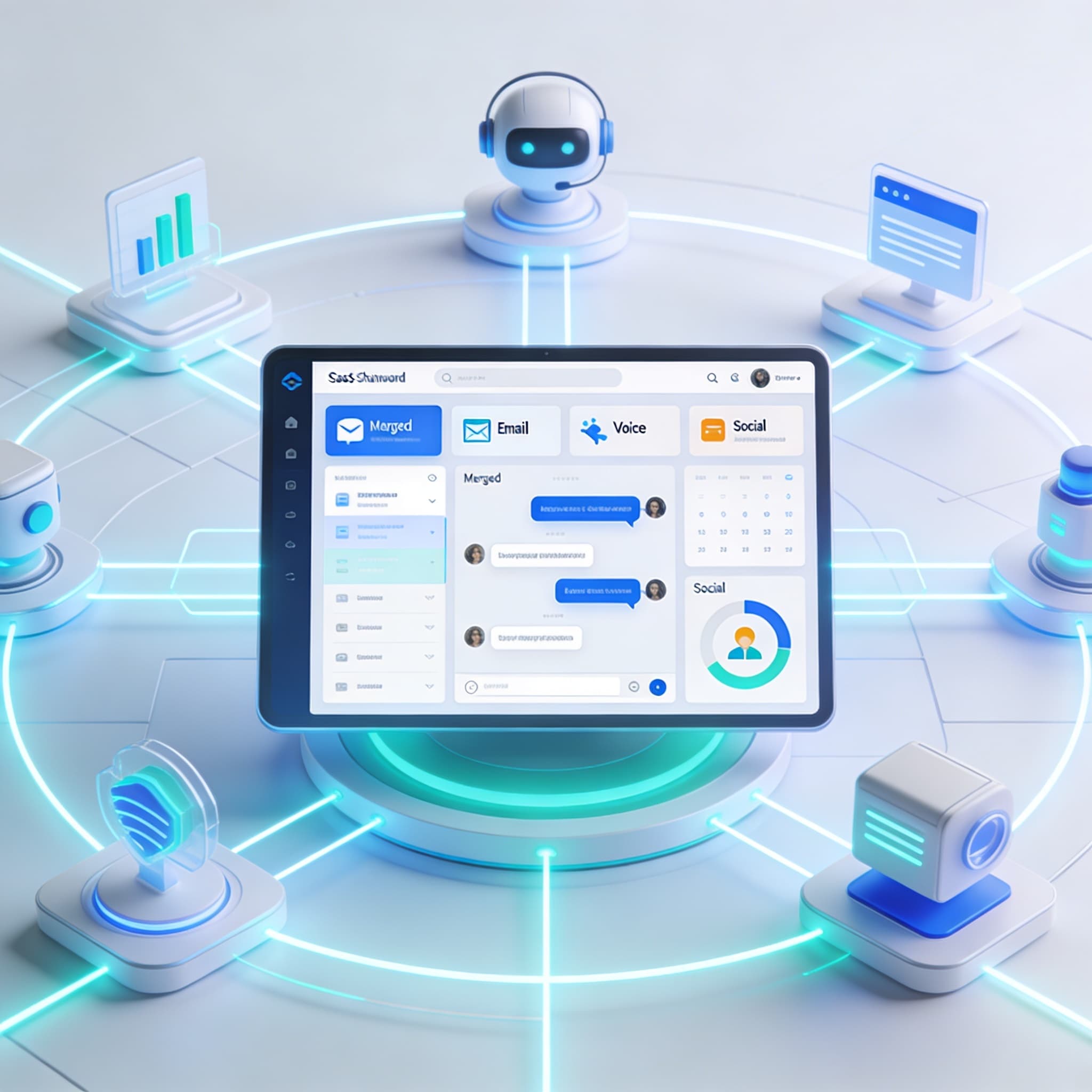
- An omnichannel inbox that unifies WhatsApp, Instagram, Email, SMS, and Voice.
- A visual no-code Bot Journey Builder enabling automation without engineering dependencies.
- AI Agents capable of tool-calling — directly interacting with APIs, CRMs, and backend systems.
- A full-stack ticketing + CRM + analytics ecosystem.
Unlike Zendesk or single-channel competitors, Lodgestory’s ecosystem integrates customer engagement, AI automation, and operational insight natively — no middleware needed.
AI and Agentic Architecture
At the core are Lodgestory’s AI Agents, powered by OpenRouter and customizable through embedded knowledge bases. They:
- Interpret intent with contextual embedding search.
- Call APIs directly to perform actions (process refunds, pull bookings, update records).
- Hand off complex cases to human agents when required.
This bridges human-AI collaboration efficiently, achieving real-world automation of 60–75% of routine queries. Unlike outdated “containment metrics,” Lodgestory measures true resolution — i.e., tasks completed successfully end-to-end.
Learn more about Lodgestory’s AI orchestration framework in The Era of Agentic AI: How Multi-Agent Orchestration is Redefining Customer Journeys.
Integrated Voice and WhatsApp Automation
Voice remains an essential human channel. Lodgestory embeds full Voice/IVR (FreeSWITCH) and WebRTC softphone capabilities within the same omnichannel workspace, connecting call logs, chat context, and CRM records seamlessly.
For WhatsApp-first markets, Lodgestory integrates the [official Meta Cloud API] and offers pre-approved template broadcasts, advanced analytics, and AI-powered campaign orchestration. Explore more in The Top WhatsApp Marketing Features in 2026: What Businesses Can Do with Lodgestory.
Built-In Content Studio and E-commerce Tools
Beyond customer service, Lodgestory integrates a Content Studio for blog and video automation — enabling marketing teams to produce SEO-rich content and voice-based video explainers with ease. Combined with its e-commerce storefront (with Razorpay integration), Lodgestory empowers brands to engage, sell, and support from a single platform.
In essence, Lodgestory is the first truly omnichannel AI platform — blending operational, conversational, and commercial workflows.
Implementation Considerations: Migration Without Friction
Migrating from Zendesk traditionally requires two to six weeks of dual operation for data integrity. Lodgestory’s migration team has optimized this with import tools for historical ticket, contact, and channel data, minimizing downtime and ensuring SLA continuity.
Need to evaluate total cost implications? Explore our in-depth comparison: The True Cost of Zendesk Alternatives: A 2026 TCO Breakdown.
Comparative Summary: Top Zendesk Alternatives 2026
| Category | Platform | Strengths | Limitations | Ideal For |
|---|---|---|---|---|
| Traditional | Freshdesk | Familiar UX, affordable tiers | Limited AI depth | SMBs and startups |
| Traditional | Help Scout | Simplicity, easy onboarding | No SLAs, no voice | Small teams |
| Traditional | Zoho Desk | Integrated with Zoho CRM | Limited flexibility | Zoho users |
| Traditional | LiveAgent | Affordable omnichannel | Basic AI | BPOs, SMBs |
| CX Suite | Salesforce Service Cloud | Enterprise scale & AI routing | Very high cost | Large enterprises |
| CX Suite | HubSpot Service Hub | CRM + marketing integration | Limited AI autonomy | Mid-market SaaS |
| CX Suite | Intercom (Fin) | Generative AI, in-app messaging | No voice | Product-led enterprises |
| AI-Native | Lorikeet | Workflow automation | Early-stage market | AI-driven operations |
| AI-Native | Ada | Multilingual AI | Expensive for scale | E-commerce, B2C |
| AI-Native | Forethought | Integrates with Zendesk/SF | Not full replacement | Enterprises augmenting legacy |
| All-in-One | Lodgestory | Unified AI + Voice + CRM + Campaigns | None (as of 2026 edition) | Hospitality, logistics, travel, healthcare, SaaS |
Conclusion: The Post-Ticket Era
The best Zendesk alternatives in 2026 aren’t just cheaper or simpler — they’re smarter. Organizations now measure success by true resolution rates and customer retention outcomes, not email backlog size. Solutions like Salesforce or Intercom bring valuable vertical depth, but only platforms like Lodgestory unify omnichannel communication, automation, and intelligence on one cohesive foundation.
If your support goals in 2026 include reducing response time by 40%, automating up to 70% of incoming queries, and orchestrating voice or messaging campaigns directly from one workspace — now’s the time to make the shift.
Sign up with Lodgestory’s Free Forever Plan and experience the future of AI-first, omnichannel customer support.
Related Reads
- The True Cost of Zendesk Alternatives: A 2026 TCO Breakdown
- The Era of Agentic AI: How Multi-Agent Orchestration is Redefining Customer Journeys
- Top 10 Customer Success Platforms to Elevate Your CX Strategy in 2026
- The Next Wave of AI-First CRM: How Lodgestory Is Redefining Relationship Management for 2026
- About Lodgestory – The Omnichannel AI Platform Redefining Business Conversations