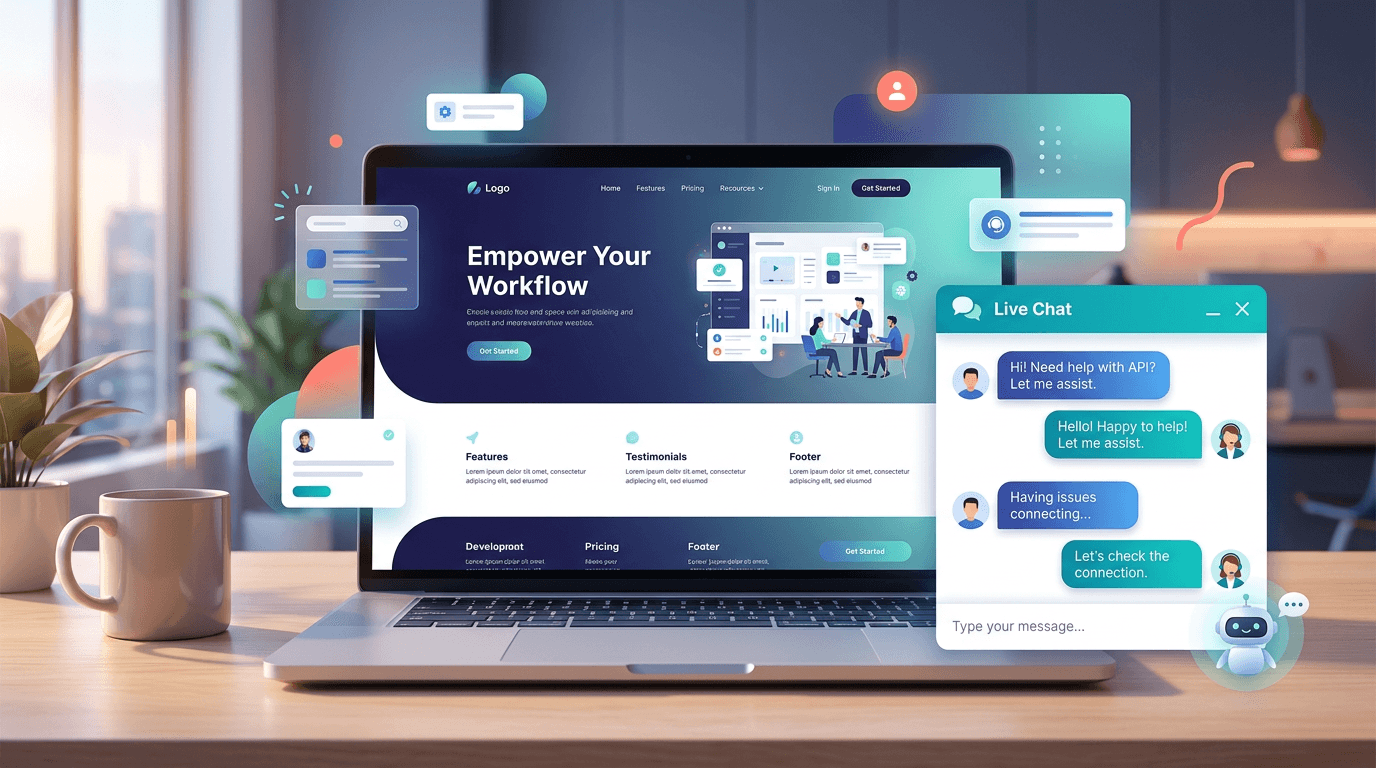
Live chat is often filed under sales tools, but its biggest impact is on customer service. Customers who are stuck on a booking, a delayed shipment or a confusing checkout want an answer in seconds, on the page where the problem happened. They do not want to find a phone number or wait on an email thread.
The data points the same way. Early digital-experience research found that 53% of customers prefer to engage with companies through chat, while only 31% of businesses offered it at the time. Since then the gap has narrowed. Software Advice figures cited by Zoho show that roughly 85% of businesses had added live chat by 2025, and Comm100 reported a 43% year-over-year rise in chats handled per representative. Chat is now a baseline expectation. What separates good support teams from average ones is how well they run it.
This guide covers eight benefits of live chat for customer service, backed by recent benchmarks. It also shows how the Lodgestory Chat Web Widget, together with our unified inbox, bot journeys and AI agents, helps you capture each one without growing headcount.
What Is Live Chat for Customer Service?
Live chat is a real-time messaging channel embedded in your website or app. Customers can reach a human agent, a bot or an AI agent without leaving the page. It differs from email because the conversation is immediate. It differs from phone because customers can keep browsing, working or multitasking while they chat.
Paired with automation, live chat does three jobs at once:
- It answers routine questions instantly.
- It captures context such as who the customer is, what they were viewing and what they need.
- It routes complex issues to the right team with the full history attached.
Lodgestory's Chat Web Widget plugs into any site. It supports HTML/static sites, React, Next.js, Vue 3, Nuxt 3, Svelte/SvelteKit, Angular, WordPress and Shopify, with custom styling to match your brand. Every conversation lands in the same shared inbox as your WhatsApp, Instagram, Email, SMS and Voice conversations.
Benefit 1: Higher Customer Satisfaction and a Better Overall Experience
The first and most consistent benefit is satisfaction. Across independent studies, live chat ranks among the highest-rated support channels:
- Saasworthy data cited by Zoho puts overall live chat satisfaction at 83.1%.
- Freshworks reports 73% satisfaction for live chat, compared with 61% for email and 44% for phone.
- Comm100's large-scale benchmark, covering hundreds of millions of interactions, shows average chat CSAT holding at roughly 80% (79.9-80.8%) through 2024, even as volumes and automation grew.
- A 2022 meta-analysis of 29 studies on live chat service quality found that responsiveness, competence, empathy and ease of use strengthen trust, commitment and repeat-purchase intent.
Three factors drive these scores: immediacy, low effort and context. Freshworks found that 60% of customers are more likely to revisit a site that offers live chat, and 44% of online shoppers see it as essential on e-commerce sites.
Lodgestory supports all three. The widget keeps support on the page where the question arose. The CRM attaches contact properties and past conversations to every chat, so customers never have to repeat themselves. Our reports include goal conversion and chat reports, so you can measure CSAT trends instead of guessing. For a deeper look at benchmarks, see What Is a Good CSAT Score and How Do You Benchmark It in 2026?.
Benefit 2: Real-Time Speed and Faster Resolution
Speed is the reason customers choose chat, and it is also where chat is easiest to lose. Consider the numbers:
- Around 90% of customers expect an immediate response in live chat.
- Industry benchmarks put average live chat response times near 15 seconds, with about 80% of chats answered within 40 seconds.
- Comm100's 2024 data shows an average wait time of 23.6 seconds and an average reply time of 44.8 seconds inside conversations.
- Replying within five to ten seconds is associated with CSAT as high as 84.7%.
- Slow responses are costly. Research cited by Digital Minds BPO suggests many customers abandon chats out of frustration, and about 1 in 5 will drop a product or service after slow chat support.
Speed also affects resolution. Benchmarks suggest first-contact resolution for chat typically falls in the 70-75% range, and a majority of companies say they resolve most complaints in the first chat.
How Lodgestory helps:
- Instant first response. A bot journey or AI agent greets every visitor immediately, so the first-response clock is no longer tied to agent availability.
- Canned responses with shortcodes. Agents insert approved answers in one keystroke. See Canned Responses in 2026.
- Smart assignment. Chats go to the right team or agent based on availability and department.
Teams using Lodgestory typically respond up to 40% faster. To track the metrics that matter, read Understanding First Response Time (FRT) and Understanding and Reducing Average Resolution Time.
Benefit 3: Always-On, 24/7 Support
Customers do not stop needing help when your office closes. Smoke Cartel, an e-commerce brand, discovered that most of its inquiries arrived outside staffed hours. Its email backlog grew past 800 messages, with replies taking more than two weeks. After it launched around-the-clock messaging support integrated with its store data, it cut average response time by 93%, from two days to about one hour. Customer satisfaction rose 11% even as the team handled more conversations.
You do not need a night shift to get similar coverage. With Lodgestory you can combine:
- No-code bot journeys that collect details, show quick-reply buttons, answer FAQs and book appointments overnight.
- AI agents backed by your knowledge base. The agent searches your uploaded documents using semantic retrieval and replies in natural language.
- Tool calling. The agent can call your APIs to check a booking, track a shipment or look up an order, then respond with real data.
- Clean handoff in the morning. When a case needs a human, the agent transfers it with the full transcript, or the system raises a ticket with priority and SLA tracking.
A vacation rental company, for example, can let the widget answer check-in time, parking and Wi-Fi questions at 2 a.m., while a late-arrival issue is flagged as high priority for the duty manager. See how hotels approach this in Customer Success Stories: How Hotels Use Lodgestory to Transform Guest Experience.
Benefit 4: Proactive Assistance That Prevents Problems
Live chat is not only reactive. When you engage customers at the right moment, you resolve problems before they become complaints.
ScottishPower embedded chat directly into error messages in its online account portal, so customers struggling with log-ins and paperless billing got help at the point of friction. The approach handled about 300 contacts a week and increased same- or next-day resolution.
Here are some ways to apply the same idea with Lodgestory:
- Trigger chat on high-friction pages such as checkout, payment, booking modification and login, with a journey that offers help specific to that step.
- Follow up across channels. If a visitor leaves a question unanswered, send a WhatsApp or email follow-up using approved templates. Campaigns support variable substitution and per-recipient delivery tracking.
- Use event waits and delays in journeys to check in after a delivery date, before a check-in or after a support interaction.
- Collect feedback at the end of every chat with automated surveys. See 7 Proven Customer Feedback Automation Strategies.
Proactive messaging turns support from a cost centre into a retention tool.
Benefit 5: Seamless Omnichannel Continuity
Live chat should not be an island. Customers start on your website, continue on WhatsApp and sometimes end up on a call. If each channel keeps its own records, the customer has to explain the issue again at every step.
Gartner's recent analysis of customer service leadership predicts digital-first tools such as live chat, self-service and knowledge management will soon outrank phone and email in perceived value. Zendesk and Nextiva guidance both stress that preserved context across channels is what makes support feel seamless.
Lodgestory is built for exactly this. Your widget conversations sit beside WhatsApp (via the official Meta Cloud API), Instagram DM, Facebook Messenger, Email, SMS and Voice in a single inbox, tied to one contact record. A customer who chats on your site and later messages on WhatsApp is the same person to your agents.
Voice is where many competitors stop. Lodgestory also offers IVR, click-to-call, call recording, a WebRTC softphone and supervisor tools such as monitor, whisper and barge. When a chat needs a conversation, the agent can place the call from the same workspace. Learn more in 10 Essential Features Every Omnichannel Customer Support System Needs.
Benefit 6: A Personal, Conversational Experience
Customers dislike robotic, scripted answers. Slow, impersonal responses are a common reason chats are abandoned. The good news is that chat is naturally conversational: customers write the way they speak, and agents can respond with warmth and detail.
To make chats feel personal rather than generic:
- Use CRM data. With custom contact properties such as loyalty tier, booking dates or preferred language, agents and bots address the customer by name and with the right context.
- Let AI extract variables from the conversation. Lodgestory's AI agents pull details such as order number, travel date or party size, so the customer answers each question once.
- Make bots feel human. Use free-text prompts with AI validation instead of rigid menus, and add a clear path to a person at any time.
- Respect language. Customers want help in their own language. See Multilingual Customer Experience at Scale.
Trust matters as much as tone. If you are deploying generative AI, read Designing Trustworthy Generative AI Self-Service Systems.
Benefit 7: Support at Scale Through Automation and Multi-Chat Handling
A common worry is that adding chat will flood the team. In practice the opposite happens when chat is paired with automation. Agents can handle multiple conversations at once, unlike phone, where one agent serves one caller. Bots and AI agents absorb the repetitive volume.
Lodgestory customers can automate up to 70% of routine queries. Here is a practical way to get there:
- Audit your top 20 questions. Look at recent tickets and chats to find repeats such as order status, opening hours, cancellation policy and booking changes.
- Build journeys for structured flows. Use buttons, lists, date pickers, API calls and conditional branching for tasks like rescheduling an appointment.
- Train an AI agent on your knowledge base for open-ended questions, and define trigger conditions for when it should exit to a specific journey path or a human agent.
- Set up ticketing with SLAs. Priority levels (SOS, High, Medium, Low) and custom issue categories ensure nothing stalls after a handoff.
- Review weekly. Use chat and ticket reports to see which topics still reach humans and automate those next.
For the full playbook, see 11 AI Automation Strategies to Scale Customer Service with Lodgestory and How AI Chatbots Can Improve Customer Service Efficiency If Crafted Carefully. If you are weighing platform costs, our TCO breakdown of Zendesk alternatives shows how per-seat pricing can balloon.
Benefit 8: Higher Conversion, Better Insights and Lower Cost to Serve
The last benefit connects service to revenue and operations.
- Conversion. Shoppers who get an answer while they browse are more likely to buy. If you sell online, the widget works on Shopify, and Lodgestory's storefront and Razorpay payment links let an agent or bot complete a sale inside the chat. See How to Build an AI Chatbot for Shopify Using Lodgestory.
- Insight. Every chat is a record of what customers actually ask. Lodgestory's analytics cover chat, contact, ticket, call log and goal conversion reports, with date filters and downloadable exports.
- Cost. Automation, multi-chat handling and fewer repeat contacts reduce your cost per resolution. For hotels, this often means fewer front-desk calls.
Be realistic about adoption, though. YouGov data shows that in the US only about 31% of people use live chat and 10% say it is their preferred method, while phone and email are often used out of necessity. Live chat is growing fastest among younger, digitally fluent and higher-income customers. The best approach is not to replace other channels but to offer chat as one well-integrated option, which is why the omnichannel foundation in Benefit 5 matters.
Common Live Chat Pitfalls (and How to Avoid Them)
- Slow first response. Use bot journeys or AI agents to answer instantly, and set alerts for waiting chats.
- Scripted, impersonal replies. Blend automation with easy human escalation and personalised data.
- No ownership after handoff. Convert unresolved chats into tickets with an assigned owner. See Assign Ticket in Omnichannel Support.
- Poor measurement. Track response time, resolution time, CSAT and abandonment. See What Is Abandonment Rate and How Lodgestory Helps Businesses Reduce It.
- Siloed channels. Keep chat, WhatsApp, email and voice in one inbox.
How to Get Started with Live Chat in Lodgestory
- Install the Chat Web Widget on your site using the guide for your stack (HTML, React, Next.js, Vue 3, Nuxt 3, Svelte/SvelteKit, Angular, WordPress or Shopify), and style it to match your brand.
- Upload your knowledge base so the AI agent can answer from your own policies and FAQs.
- Build a welcome journey with quick-reply buttons for the top reasons people contact you.
- Define handoff rules: which topics go to humans, which create tickets and which carry which priority.
- Add canned responses for your agents.
- Review reports weekly and refine.
Conclusion
Live chat is no longer just a sales add-on. It is a core part of customer service that raises satisfaction, speeds up resolution, extends support hours, enables proactive outreach, unifies channels, personalises conversations, scales through automation and feeds revenue and insight. The teams that get the most from it treat chat as part of a connected, omnichannel system rather than a stand-alone widget.
Lodgestory brings the widget, shared inbox, bot journeys, AI agents, ticketing, CRM, campaigns, voice and analytics together in one workspace, built for hospitality, logistics, healthcare and travel teams, and equally useful for e-commerce and SaaS.
Ready to see it on your own website? Sign up with the Free Forever Plan and have live chat running in your stack today. To explore the wider platform, read Why Lodgestory Stands Out Among Omnichannel Customer Experience Platforms.