Every customer experience leader eventually hears the same question from the boardroom: how does AI improve customer experience, and can you prove it? The honest answer is that AI improves CX only when it is tied to specific, measurable outcomes: shorter response times, higher CSAT, more queries resolved without human effort, and more revenue from conversations that used to be dead ends.
At Lodgestory, we see this every day across hospitality, logistics, healthcare, and travel teams. Customers expect instant, personal, and consistent service on the channel they already use, whether that is WhatsApp, Instagram, email, SMS, or a phone call. Teams that adopt AI thoughtfully respond 40% faster and automate up to 70% of incoming queries, freeing human agents for the conversations that truly need empathy and judgment.
This guide breaks down seven measurable ways AI improves customer experience, which metric each one moves, and how to put each into practice.
Why AI Matters for Customer Experience Right Now
Customer expectations have outpaced traditional support models. Industry research consistently shows that a large majority of consumers expect personalized interactions, and most report frustration when they don't get them. At the same time, message volumes keep rising as customers spread across more channels. Hiring alone cannot close the gap.
AI closes it by doing three things well:
- Speed: answering instantly, at any hour, in any volume.
- Context: using CRM data, conversation history, and knowledge bases to say the right thing to the right person.
- Prioritization: deciding which conversations need a human, and which human, before an agent ever opens the inbox.
The key point, echoed across the industry, is that the best CX is not AI instead of people. It is AI and human agents working together, with AI handling repetitive volume and people handling nuance. If you want a broader view of where this is heading, see our perspective on 10 ways AI will transform customer experience by 2026.
1. Faster Responses: Cutting First Response Time and Queue Waits
Metric moved: First Response Time (FRT), Average Speed of Answer (ASA), abandonment rate.
Speed is the most visible CX improvement AI delivers, and the easiest to measure. When an AI agent or bot journey greets every inbound message instantly, the customer's wait drops from minutes or hours to seconds. Even when a human is ultimately needed, AI can collect the details first: booking reference, issue type, preferred language. The agent picks up a conversation that is already half-resolved.
Teams using Lodgestory's unified inbox, bot journeys, and AI agents respond 40% faster on average. The gains come from three mechanisms:
- Instant acknowledgment through automated greetings and qualification flows.
- Canned responses with shortcodes so agents answer common questions in a couple of keystrokes. Our guide to canned responses shows how.
- A single shared inbox, so agents stop switching between WhatsApp Web, a mail client, and a phone system.
How to act on it: Baseline your current FRT by channel, then set a target (for example, under 60 seconds on WhatsApp and under 15 minutes on email). Our primer on understanding first response time explains how to measure it properly.
2. 24/7 Availability Without 24/7 Staffing
Metric moved: After-hours resolution rate, abandonment rate, conversion on off-hours inquiries.
A hotel guest asking about late check-in at 11 p.m., a shipper chasing a parcel on a Sunday, a patient trying to reschedule before work: none of them care about your shift schedule. AI agents backed by a custom knowledge base can answer these questions at any hour using your actual policies, FAQs, and documents.
Lodgestory's AI agents use retrieval-based search over your uploaded documents and external item data, so answers come from your content rather than generic model guesses. When a question falls outside the knowledge base, the agent can exit to a defined journey path, such as creating a ticket or handing off to a human the next morning, instead of improvising.
What to measure:
- Share of conversations started outside business hours.
- Percentage of those resolved without a human.
- Percentage that become tickets with complete information, ready for the first agent in the morning.
For hospitality teams in particular, this is where the front-desk call-volume reduction shows up first. See how hotels use Lodgestory to transform guest experience.
3. Contextual Personalization Using CRM Data
Metric moved: CSAT, conversion rate, repeat purchase or rebooking rate.
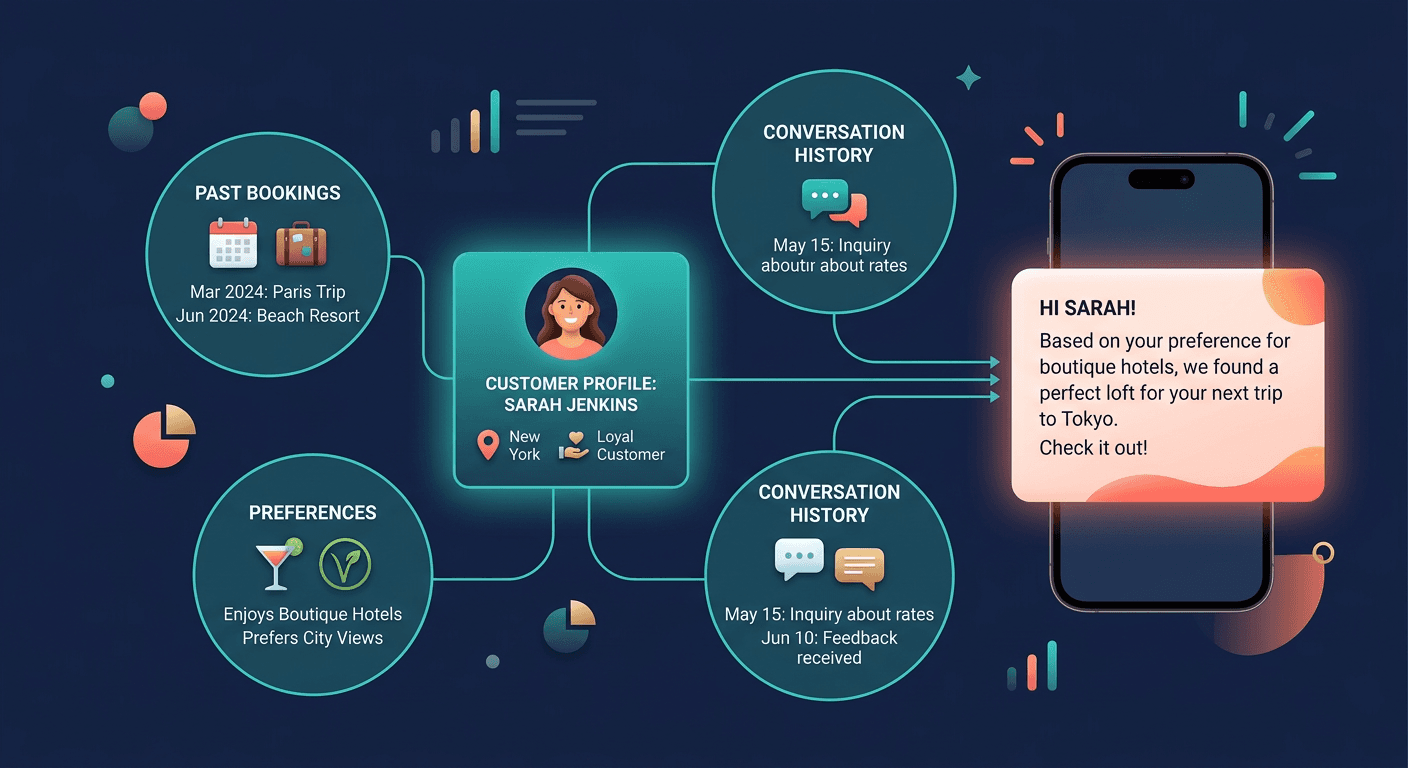
Personalization is more than inserting a first name. Real personalization means the AI knows who the customer is, what they have bought or booked, what they asked last time, and what they are likely to need next. This is where a connected CRM makes the difference between a generic chatbot and a useful assistant.
In Lodgestory, contacts carry custom properties such as loyalty tier, preferred language, booking dates, property, shipment status, or last purchase. Those properties can be used in three ways:
- Interpolated into messages. Bot journeys support variables across messages and API payloads, so a message can reference the guest's name, arrival date, and room type automatically.
- Used to branch journeys. Conditional logic can send a VIP guest down a different path than a first-time visitor.
- Passed to AI agents as context. Agents can call your own APIs, such as a PMS or booking system, to pull live reservation or order data mid-conversation and answer with specifics.
A customer who gets an answer specific to their booking, in their language, on the channel they started on, rarely needs a second message.
This is the core of what we mean by an AI-driven personalized customer journey. Instead of a fixed funnel, each customer gets a path shaped by their data and behavior. For a deeper dive into the data side, read Personalization at Scale: Using CRM Data to Power Smarter Marketing Automation.
Example: A vacation rental company segments contacts by property and stay dates. Three days before arrival, a journey sends a WhatsApp message with check-in instructions and offers an early check-in upgrade. Replies flow to an AI agent that checks availability through the booking API. The result: higher upsell revenue and fewer where do I go? calls.
4. Proactive Messaging: Solving Problems Before Customers Ask
Metric moved: Inbound ticket volume, no-show rate, NPS, upsell revenue.
Reactive support, however fast, still starts with a customer who is already inconvenienced. Proactive messaging flips that. AI and automation let you reach out at the right moment with the right information:
- Booking confirmations and pre-arrival instructions.
- Shipment delays and delivery windows.
- Appointment reminders with one-tap reschedule buttons.
- Post-stay or post-purchase feedback requests and review prompts.
Lodgestory supports broadcast campaigns using approved WhatsApp templates with variable substitution, scheduled delivery, and per-recipient delivery tracking. Individual messages can also be scheduled for a future date, which is handy for reminders tied to a specific booking. Journeys can wait for events or add delays, so a follow-up fires only when the customer hasn't responded.
The measurable payoff is deflection: every delay notice or reminder sent proactively is a where is my order? ticket that never gets opened. Combine this with quick-reply buttons and interactive lists, and customers can confirm, reschedule, or opt in with one tap. For template strategy, see our WhatsApp notification templates guide and the template approval and compliance checklist.
5. Sentiment-Aware Routing: Getting the Right Customer to the Right Human
Metric moved: CSAT on escalated conversations, escalation time, repeat contact rate.
Not every conversation should be automated. A frustrated customer who reports a billing error or a safety concern needs a person, quickly. AI helps by recognizing urgency and emotion in the conversation and acting on it.
In Lodgestory, you can configure AI agents with trigger conditions that exit to specific journey paths. For example, repeated failed answers, negative language, or keywords like refund, cancel, or complaint can route the conversation to an agent-transfer node, or open a ticket with an elevated priority. The ticketing system supports priority levels (SOS, High, Medium, Low), issue category hierarchies, and agent assignment tracking, so an urgent case doesn't sit in a general queue.
For voice, department-based routing, call monitoring, whisper, barge, and transfer features give supervisors the tools to step in on a tense call. If you want to explore this more, read about sentiment analysis tools and smart call routing.
Practical routing rules to start with:
- Escalate immediately when a customer asks for a human.
- Escalate after two consecutive low-confidence AI answers.
- Flag SOS priority for safety, payment failure, or VIP contacts.
- Route by language and department before assigning to an individual agent.
6. Higher Automation Rates Through AI That Takes Action
Metric moved: Automation (containment) rate, cost per resolution, Average Handling Time (AHT).
The jump from answering questions to completing tasks is what separates a basic chatbot from an AI agent. Lodgestory's AI agents support tool calling: they can invoke custom HTTP APIs defined for your organization, run multi-turn tool chains, and extract variables from the conversation. In practice, that means the AI can:
- Look up a reservation, modify dates, and confirm the change.
- Check shipment status with a tracking number.
- Create a support ticket with the right category and priority.
- Generate a payment link through the Razorpay integration.
This is how teams reach automation rates of up to 70%. The queries that used to need a person (status checks, simple changes, FAQs, and form collection) are handled end to end. Human agents see fewer repetitive questions and spend more time on complex cases, which also lifts agent satisfaction and reduces turnover.
To get there safely, follow a sequence:
- Map your top 20 intents by volume from existing chat and ticket data.
- Automate the top five with bot journeys or AI agents and measure containment.
- Add tool calls for the intents that need live data.
- Review failed conversations weekly and update the knowledge base.
Our 11 AI automation strategies post goes deeper on sequencing, and How AI Chatbots Can Improve Customer Service Efficiency If Crafted Carefully covers design pitfalls. For the metrics side, see Understanding Average Handling Time.
7. Continuous Insight: Turning Every Conversation into Data
Metric moved: CSAT trend, goal conversion rate, time-to-insight.
Every AI-assisted conversation produces structured data: intents, outcomes, sentiment, handoff reasons, and goal completions. Used well, that data tells you what to fix upstream (confusing policies, recurring product issues, gaps in your knowledge base).
Lodgestory's analytics cover chat, contact, ticket, call log, and goal conversion reports, generated asynchronously with date-range filtering and downloadable exports. Bot journeys can include goal-tracking nodes, so you can attribute bookings, payments, or form completions directly to the conversation that drove them. Pair that with automated post-interaction surveys and you can track CSAT by channel, journey, and agent rather than as a single blended number.
For more on closing the loop, see Voice of the Customer 2.0 and real-time customer experience metrics.
The Scorecard: Which Metric Does Each AI Capability Move?
| AI Capability | Primary Metric | What to Track |
|---|---|---|
| Instant responses and canned replies | First Response Time | FRT by channel, ASA |
| 24/7 AI agents with knowledge base | After-hours resolution | Off-hours containment rate, abandonment |
| CRM-driven personalization | CSAT, conversion | CSAT by segment, upsell rate |
| Proactive campaigns and reminders | Inbound volume | Ticket deflection, no-show rate |
| Sentiment and priority routing | Escalation quality | Time to human, repeat contacts |
| Tool-calling AI agents | Automation rate | Containment %, cost per resolution |
| Analytics and goal tracking | Continuous improvement | CSAT trend, goal conversions |
A useful rule: pick one headline metric per initiative, set a baseline before launch, and review at 30, 60, and 90 days. Our guide to 15 essential contact center metrics can help you choose.
Common Mistakes That Undermine AI-Driven CX
AI can hurt customer experience when it is deployed carelessly. Watch for these traps:
- No escape hatch. Customers should always be able to reach a person. Make human handoff obvious and fast.
- Stale knowledge. An AI agent is only as good as its source content. Assign an owner to keep the knowledge base current.
- Channel silos. If the AI on WhatsApp doesn't know what happened on email, customers repeat themselves. A unified inbox and CRM prevent this.
- Measuring only containment. A high automation rate with falling CSAT means the AI is blocking customers, not helping them. Always track both.
- Ignoring trust. Be transparent when customers are talking to AI, and design answers to cite policy rather than guess. See designing trustworthy generative AI self-service systems.
A 30-Day Plan to Get Started
Week 1: Baseline. Pull FRT, resolution time, CSAT, and top contact reasons from the last 90 days.
Week 2: Build. Connect your channels to the unified inbox, upload FAQs and policy documents to a knowledge base, and create a bot journey for your top three intents.
Week 3: Personalize. Enrich contacts with the custom properties that matter (language, tier, booking or order data) and add variables and conditional branches to your journeys.
Week 4: Launch and learn. Go live on one channel, set escalation rules and ticket priorities, and review conversation logs daily. Expand to additional channels once containment and CSAT are stable.
Bringing It All Together
So, how does AI improve customer experience? By making every interaction faster, more available, more relevant, more proactive, and better routed, and by giving you the data to prove it. The seven levers above are not abstract promises. Each one maps to a metric your team can baseline and improve.
Lodgestory brings these capabilities into one workspace: a unified inbox across WhatsApp, Instagram, email, SMS, and voice; a no-code bot journey builder; AI agents with tool calling and knowledge bases; a CRM with custom properties; ticketing with SLA tracking; and analytics that tie it together. That is how our customers respond 40% faster and automate up to 70% of queries without losing the human touch.
Ready to see the impact on your own metrics? Sign up with Free Forever Plan and build your first AI-powered journey today. For a broader look at the platform, explore AI Agents for Business and Lodgestory: The AI-First Omnichannel CRM.