AI in customer experience is no longer an experiment. It is operational infrastructure. The teams that win in 2026 will not be the ones that bolt on the most AI. They will be the ones that set the clearest boundaries around where AI can act, where it can assist, and where it must stop and hand over to a person.
At Lodgestory, we see this shift every day across hotels, vacation rental companies, logistics providers, healthcare clinics, and travel agencies. Customers no longer want a bot that talks politely about their problem. They want the booking changed, the delivery rescheduled, the appointment confirmed, and the refund issued, on the channel they already use. This guide breaks down the five CX trends redefining 2026 and shows how to turn each one into a practical operating model.
The 2026 CX Landscape: From Pilot to Production
The numbers show how quickly AI has moved from the lab into the contact center:
- Industry analysts estimate the global contact center AI market at roughly USD 5.4 billion in 2026, up from USD 4.3 billion in 2025, and projected to reach about USD 39.1 billion by 2035 (a CAGR near 24.6%).
- Gartner research indicates that AI spending among service leaders grew by 38% in 2026, while overall service and support budgets grew by only about 2%. Money is clearly being reallocated toward AI.
- Salesforce's service survey found that teams estimate about 30% of cases are already handled by AI, with expectations of 50% by 2027.
- One compilation of global statistics reports that 98% of contact center managers say AI is part of their workflows in some form.
And yet there is a gap. Gartner's 2026 leadership analysis suggests that only about 11% of service leaders say their generative AI investments have met their primary business objective, and roughly 24% report positive financial returns. Stanford's Digital Economy Lab, studying 51 enterprise AI deployments, found that executive sponsorship was the most common accelerator of time to value (43% of cases) and that production success depends on rebuilding workflows, not on assuming AI will behave like a human employee.
In other words, the problem in 2026 is not access to AI. It is execution design. If you want a deeper look at why adoption and integration diverge, read our guide on bridging the AI adoption-integration gap.
Trend 1: Agentic Resolution, AI That Completes Outcomes, Not Just Replies
Agentic resolution means AI that understands a customer's need, reasons about the right action, and carries it out in connected systems. Instead of explaining how to change a reservation, it changes the reservation. Instead of linking to a refund policy, it checks eligibility and processes the refund.
Vendor data shows how far this has advanced. NICE reports that its agentic products resolve 70 to 88% of interactions end-to-end in suitable use cases, and Gartner projections cited across the industry suggest agentic AI could autonomously resolve around 80% of common service issues by 2029, with operating cost reductions near 30%. Gladly's customer research found that 88% of customers said their issue was resolved through AI or a mix of AI and human help, but only 22% said the experience made them prefer the brand. Resolution alone is not loyalty. How you resolve matters.
How Lodgestory turns conversation into execution
Lodgestory's AI Agents with Tool Calling are built for exactly this. Each agent can:
- Call custom HTTP APIs that you define for your organization, for example a PMS lookup, a booking modification endpoint, a shipment tracking service, or a payment link generator.
- Run multi-turn tool chains, such as checking a reservation, confirming availability, applying the change, and sending a confirmation, within a single conversation.
- Extract variables from the conversation (dates, order numbers, guest names) and pass them into journeys and API payloads.
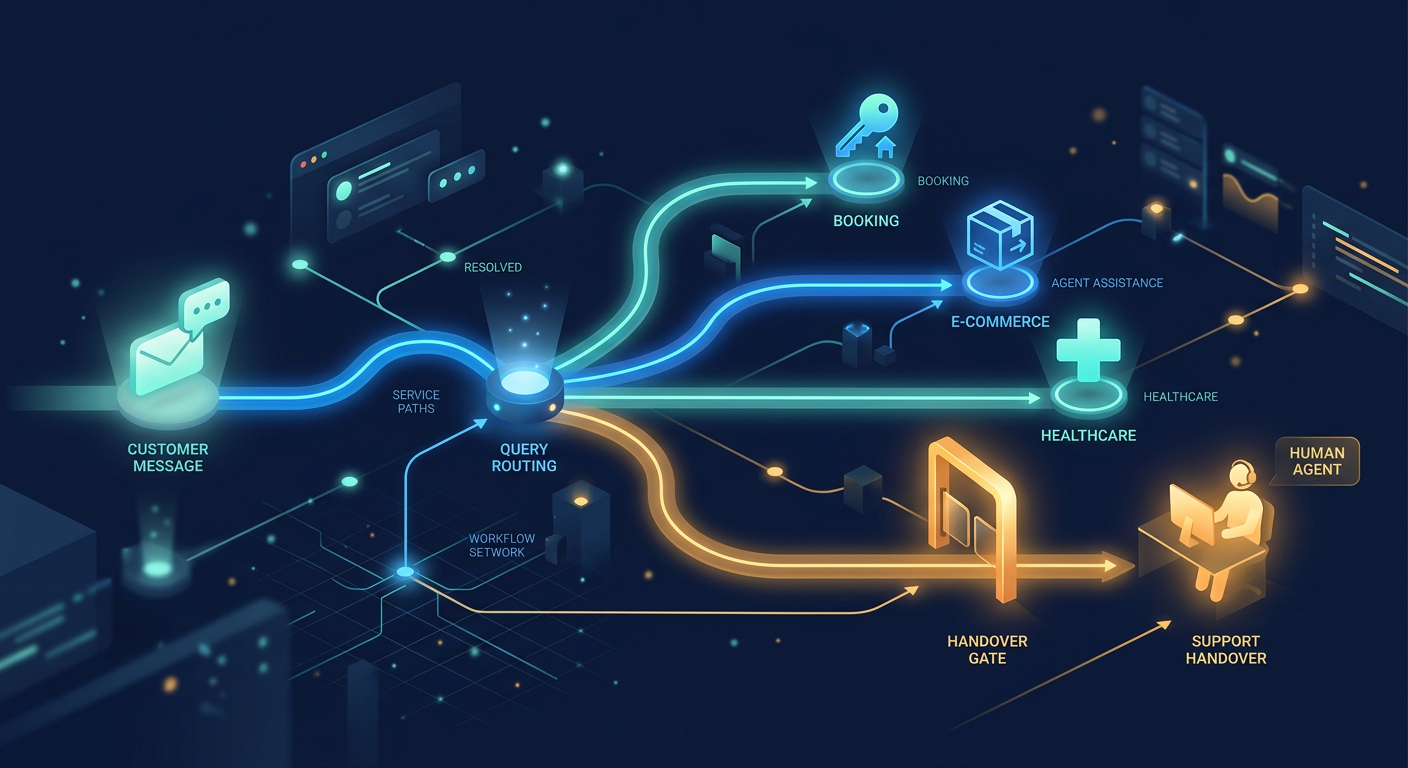
- Exit to specific journey paths when configurable trigger conditions are met, such as a refund over a threshold or an angry customer, so that the right workflow or human takes over.
A few examples of what this looks like in practice:
- Hotels and resorts: A guest messages on WhatsApp asking for a late checkout. The AI agent queries the property system, checks the next arrival, confirms or declines, posts a note to the reservation, and offers a paid upgrade if late checkout is unavailable.
- Logistics: A customer asks about a delayed parcel. The agent pulls live shipment status, explains the delay, reschedules delivery, and, if the delay breaches the promised window, opens a prioritized ticket automatically.
- Healthcare clinics: A patient asks to move an appointment. The agent validates identity through a free-text prompt with validation, checks open slots, rebooks, and sends a reminder.
To see the broader philosophy, explore how Lodgestory is turning conversations into actions and the era of multi-agent orchestration.
Redesign the process before you automate it
HGS and others make a pointed observation: the biggest risk of AI-driven CX is not occasional failure, it is a failure replicated across thousands of interactions before anyone notices. Human agents lean on tacit knowledge and informal workarounds. AI needs those made explicit.
Lodgestory's visual Bot Journey Builder is where that translation happens. With 16+ node types (conditional branching, API calls, delays, event waits, goal tracking, agent transfer, and AI agent handoff), teams can map steps, exceptions, and escalation thresholds in a no-code canvas. Start with the three or four request types that make up most of your volume, map them, and let the AI agent handle the conversational layer while the journey enforces the business rules.
Trend 2: Trust-First AI, Governance as Table Stakes
Consumers are enthusiastic about faster resolution but wary of opaque automation. Research cited across the industry shows that around 87% of customers insist on access to a human when generative AI is used in service. Regulators and standards bodies are also pushing companies toward more rigorous governance for customer-facing AI. In 2026, trust is a design requirement, not a brand slogan.
A simple autonomy policy
The most useful governance tool we recommend is a written autonomy policy that classifies every customer action as act, assist, or stop. For example:
Action                     | AI mode  | Condition
---------------------------|----------|------------------------------
FAQ and policy questions   | ACT      | Answer from approved knowledge base only
Booking date change        | ACT      | Within free-change window
Refund                     | ASSIST   | AI prepares, human approves above threshold
Complaint with legal tone  | STOP     | Transfer to Team Lead, create SOS ticket
Medical advice             | STOP     | Never answered by AI
Building the policy into Lodgestory
- Grounded answers: AI agents draw on custom knowledge bases with semantic search over your uploaded documents and item data, so answers come from your approved content rather than guesswork.
- Defined tools only: Agents can only call the APIs you define for your organization. If an action is not on the list, it cannot happen.
- Explicit exits: Configurable trigger conditions send conversations to a human, a specific journey path, or a ticket with the right priority (SOS, High, Medium, Low).
- Access control and isolation: Organization-scoped data isolation and role-based access (Account Owner, CRM Admin, Team Lead) keep data and permissions tight.
- Always a human option: Agent transfer is available as a node in every journey, and canned responses keep human replies fast and consistent.
For design principles, see our article on designing trustworthy generative AI self-service systems and the practical view in how AI chatbots improve efficiency when crafted carefully.
The fastest CX in 2026 will also be the safest, because it is designed with clear limits on where AI can act, assist, or stop.
Trend 3: Memory-Rich CX, Continuity Across Channels and Time
Customers do not think in channels. A guest might ask about parking on Instagram, confirm arrival on WhatsApp, email a document, and call the front desk from the lobby. If each touchpoint starts from zero, the AI feels forgetful and the human team feels overworked.
Genesys, Acxiom, and CX Network all describe 2026 as the year of contextual intelligence and unified journeys, where AI interprets context and orchestrates interactions across all touchpoints. Memory is what makes that possible.
What memory looks like in Lodgestory
- One unified inbox for WhatsApp (official Meta Cloud API), Instagram DM, Facebook Messenger, Email, SMS, and Voice, with real-time updates so every agent sees the same thread.
- CRM with custom properties such as loyalty tier, preferred language, room preference, shipment account, or treatment type, plus advanced filtering (equals, contains, starts_with, gt, lt, is_empty) and contact-to-chat linking.
- Variable scopes (local, system, and campaign) that carry data through journeys and into API payloads, so the bot never asks twice for something it already knows.
- Ticketing history with priority levels, custom issue categories, media attachments, and assignment tracking, so past issues inform present conversations.
- External item webhooks that sync PMS and booking system data into vector-embedded search, so an AI agent can reason about a specific reservation or property.
A practical test: pick your five most common repeat contacts and trace what your team knows at the moment of the second contact. If the answer is 'only what the agent remembers,' memory is your next investment. Our post on personalization at scale with CRM data and the look at the next wave of AI-first CRM go deeper.
Trend 4: Hybrid Voice, Real-Time Intelligence for Agents, Automation for Customers
Voice has not disappeared. It has become more important for urgent, emotional, or complex issues, which is precisely where mistakes are costly. The 2026 pattern is hybrid voice: automation handles the routine call, and real-time intelligence supports the human on the hard one.
Lodgestory is one of the few platforms that treats voice as a first-class channel next to messaging. Capabilities include:
- IVR flows and department-based routing so callers reach the right team the first time.
- Click-to-call and a WebRTC softphone for browser-based calling, with no hardware required.
- Call recording, plus monitor, whisper, barge, and transfer for supervisors coaching agents live.
- Call logs tracking direction, duration, status, and agent attribution, feeding call log reports and goal conversion analytics.
- Multi-region SIP trunking for reliable connectivity.
The hybrid model works best when you split the labor deliberately. Let automation handle status checks, simple bookings, and after-hours queries. Let people handle bereavement, medical sensitivity, high-value negotiations, and escalated complaints, with the caller's chat history and CRM profile already on screen. A front desk that previously answered the same ten questions all day can redirect much of that volume to messaging and IVR, which is the core of how hospitality teams reduce front-desk call volume.
Go further with Lodgestory's AI call agents for inbound and outbound conversations, the guide to smart call routing, and the overview of top IVR features powering omnichannel CX in 2026.
Trend 5: Multimodal Operations, Making Sense of Messy, Real-World Inputs
Real customers send blurry photos of damaged luggage, voice notes in two languages, PDFs of invoices, and location pins from a street corner. Text-only automation breaks on this reality. Multimodal operations means capturing, understanding, and routing these inputs without forcing customers into a rigid form.
In Lodgestory, this shows up in several ways:
- Rich journey nodes: text, image, video, audio, document, location, quick reply buttons, interactive lists, date pickers, and free-text prompts with regex or AI validation. A logistics bot can ask for a delivery photo, a location pin, and an order number in a single flow.
- Ticket attachments: media captured in chat attaches directly to tickets, so the field team or back office sees the evidence without chasing the customer.
- Email with threading and forwarding: documents and long-form complaints stay connected to the same conversation.
- Multi-channel templates: one message concept, adapted per channel, with approved WhatsApp templates and variable substitution for campaigns.
- Web chat widget: the new Lodgestory chat widget plugs into HTML or static sites, React, Next.js, Vue 3, Nuxt 3, Svelte/SvelteKit, Angular, WordPress, and Shopify, with custom styling, so even website visitors enter the same unified inbox.
Multimodal also means multilingual. If your guests or patients write in many languages, pair this with multilingual customer experience at scale and a multilingual knowledge base.
A 90-Day Plan to Move from Conversation to Execution
Here is a pragmatic path we recommend to teams starting in 2026:
Days 1 to 30: Map and bound
- Export your last 90 days of conversations and tickets, and group them by intent.
- Pick the top five intents by volume that are low-risk and rules-based.
- Write the act, assist, stop policy for each one, including escalation thresholds.
- Upload your approved documents to a knowledge base and clean up outdated content.
Days 31 to 60: Build and connect
- Build journeys for each intent in the Bot Journey Builder, with explicit exceptions and agent transfer paths.
- Define the API tools your AI agent needs, starting with read-only lookups before write actions.
- Set up ticketing categories, priorities, and SLA targets so escalations land with the right team.
- Connect WhatsApp, Instagram, email, and voice routing so context flows into one inbox.
Days 61 to 90: Measure and expand
- Track containment, first response time, resolution time, CSAT, and escalation quality in analytics reports (chat, contact, ticket, call log, and goal conversion).
- Review failed and escalated conversations weekly, and fix the journey or knowledge gap behind each pattern.
- Promote proven actions from assist to act only when the data supports it.
- Add proactive journeys such as delay notices, pre-arrival messages, and appointment reminders to reduce inbound volume before it happens.
Useful companion reads include reducing average resolution time, AI-driven ticketing, and 15 essential contact center metrics.
What to Measure: Execution Metrics, Not Conversation Metrics
If AI is now operational, your scorecard should change too:
- Resolution rate, not just deflection. Did the issue actually get solved?
- Action success rate: how often tool calls complete correctly end-to-end.
- Escalation quality: when AI hands over, does the human have full context?
- Time to resolution across channels, with SLA tracking on tickets.
- Preference and loyalty signals, because resolution without empathy does not build loyalty, as the 22% preference figure above suggests.
Lodgestory customers typically see teams respond up to 40% faster and automate up to 70% of queries when journeys, knowledge, and routing are tuned together. Results vary by industry and data quality, so treat these as targets to earn rather than guarantees.
Why It Matters
The organizations that benefit from AI in 2026 are not the ones with the flashiest assistant. They are the ones that connected AI to real systems, wrote down its boundaries, kept memory across channels, protected the human option on voice, and prepared for the messy inputs customers actually send. That is controlled, outcome-driven CX, and it is what Lodgestory is built to deliver from a single workspace.
For the bigger picture, see Lodgestory: building the agentic enterprise and customer experience trends 2026.
Start Executing with Lodgestory
You do not need a giant transformation program to begin. Start with one channel, one high-volume intent, and one clear boundary, then expand as the data proves it works. Sign up with Free Forever Plan and build your first journey and AI agent today.