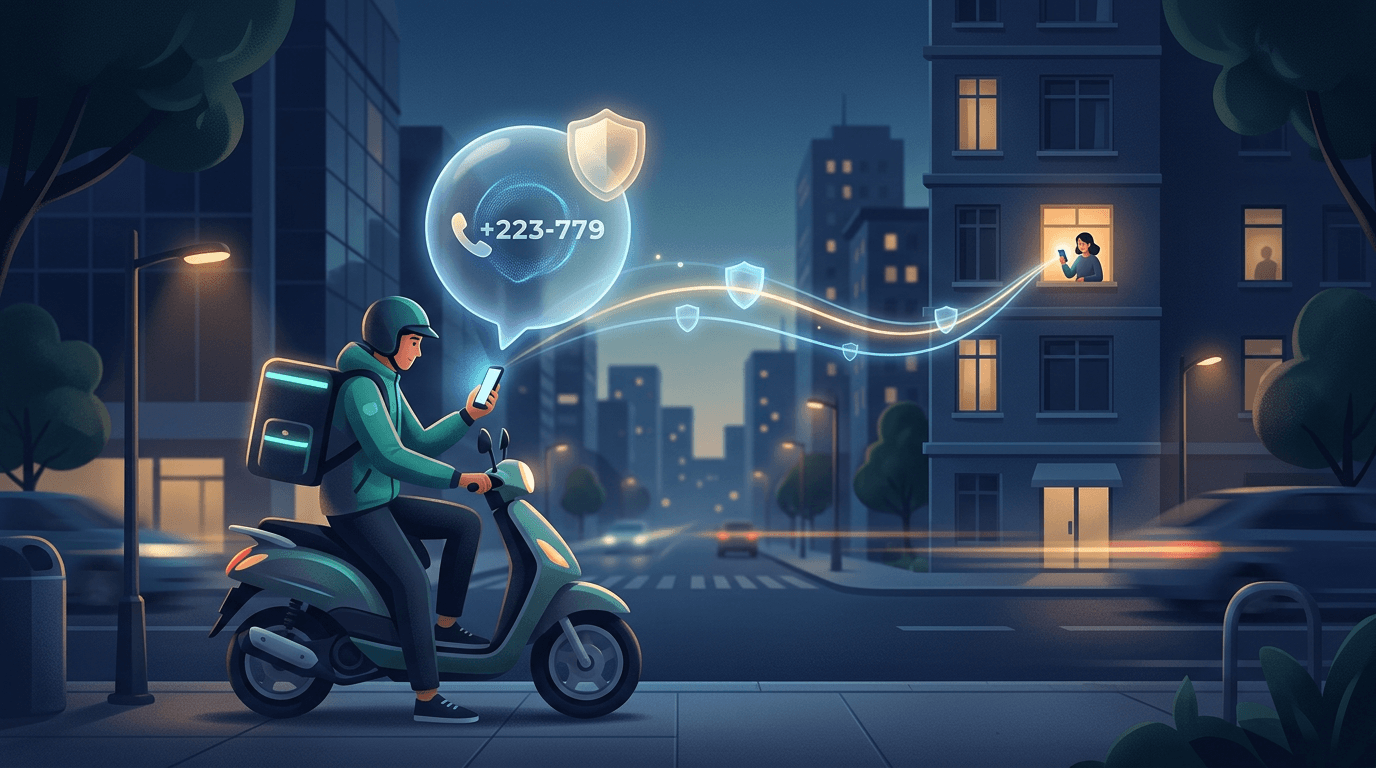
Every booking, delivery, and support request starts with a phone number. Customers hand it over when they check out online, book a room, schedule a clinic visit, or request a callback. Many businesses then let that number travel freely through agents' phones, spreadsheets, and third-party apps. The result is a privacy gap, and customers notice it. When they suspect their number will be shared or misused, they stop calling, stop replying, and stop trusting the brand.
Call masking, also called phone number masking, closes that gap. This guide explains how it works, which business benefits it delivers, where it matters most, and how Lodgestory's voice and omnichannel stack helps teams protect personal numbers while keeping conversations fast and personal.
What Is Call Masking?
Call masking is a privacy technique that lets two parties talk by voice or text without ever seeing each other's real phone numbers. A temporary or virtual number sits in the middle, and both sides see only that proxy. The telephony platform quietly bridges the conversation behind the scenes.
It differs from simply blocking caller ID. Dialing codes such as *67 in the US and Canada tell the carrier to show 'Private', 'Unknown', or 'Withheld'. That hides the caller, but it also tanks answer rates, because people rarely pick up calls with no recognizable identity. Masking works the other way. It deliberately shows a different, trustworthy number, such as a local business line, a toll-free number, or a session-specific virtual number. The call looks normal and credible, and personal numbers stay hidden.
Two terms are often confused:
- Masked number: a number shown for a particular session or transaction to hide the real one.
- Virtual number: a cloud-hosted number not tied to any physical line, used for routing calls and texts. Masking is the privacy function, and virtual numbers are the infrastructure underneath it. For a deeper look at the building block, read our guide on unlocking business growth with virtual numbers.
Why Number Privacy Is a Growing Priority
Privacy is now a budget line, not just a courtesy. Market analysts estimate the global number masking market at roughly $1.2 billion in 2025, growing to $4.8 billion by 2034, a 16.8% CAGR driven largely by tightening data privacy regulations and fraud prevention needs. The wider virtual phone number market is projected to rise from $8.0 billion in 2025 to $16.67 billion by 2034. Cloud telephony overall is forecast to grow from $37.49 billion in 2025 to $44.02 billion in 2026.
Those figures point to one shift: voice is moving from fixed desk phones to software-defined, cloud-hosted communication. In that world, a phone number is an identifier linked to a person's profile, address, and habits. Treating it as sensitive data is both good ethics and good risk management.
How Phone Number Masking Works
Most masked-call architectures share the same building blocks: call legs, a proxy number, and bridging logic. A typical ride-hailing or delivery scenario looks like this:
- A customer places an order or books a ride in the app.
- The platform assigns a driver or delivery agent.
- Either party taps a click-to-call button inside the app.
- The request goes to the telephony platform instead of dialing the other person's mobile directly.
- The platform picks a virtual number from its pool and maps it to this specific interaction.
- It places a call to each party from that virtual number and bridges the two legs into one conversation.
- Each person sees only the proxy number on their screen.
- When the call ends, or the session expires, the mapping is closed and the number returns to the pool for reuse.
A simplified view of the flow:
Customer app  -->  Click-to-call request
                      |
              Telephony platform
          (assigns proxy number, looks up
           the real numbers of both parties)
                      |
   Leg A: proxy --> Customer     Leg B: proxy --> Agent
                      |
        Bridged audio, real numbers never exposed
                      |
      Session ends --> proxy number recycled
Common session patterns
- Click-to-call: a user taps a button in an app or console, and the platform initiates and bridges the call. Everything stays on-platform, so call tracking is easy.
- Call-me / callback requests: a customer enters a number on a website, the system calls them from a business number, then connects the second party.
- Proxy dial-in: users call a dedicated relay number. Uber and Lyft use this model. Riders and drivers reach each other through anonymized relay numbers, and the number a rider sees will not work once the ride is over.
- Just-in-time sessions: a caller dials one central number, an IVR asks for an order or tracking code, and the backend resolves it and connects the caller to the right counterpart. This suits marketplaces where the set of participants changes constantly. For more on structuring those menus, see our breakdown of top IVR features powering omnichannel customer experience.
Masking is not only for voice
SMS and messaging can be masked the same way. Ride-hailing platforms send rider updates from official short codes or business numbers, never from a driver's personal line. Messaging channels such as WhatsApp, Instagram DM, and website chat also reduce exposure, because the conversation lives inside the platform and not on someone's personal handset. If you are following the evolving privacy landscape on WhatsApp, our WhatsApp username policy guide explains what is changing.
Benefits of Masking Phone Numbers
1. Stronger privacy and lower misuse risk
When agents, drivers, or vendors never see a customer's real number, they cannot save it, resell it, or contact the customer after the transaction ends. That cuts the risk of harassment, spam, and stalking, which is why ride-hailing and marketplace platforms have made anonymization a core safety feature.
2. Higher trust and better engagement
Customers are far more willing to call a business that visibly protects their details. Masking signals that the brand treats personal data seriously, and that signal turns into more callbacks, more completed bookings, and fewer abandoned conversations.
3. Local presence and higher answer rates
Because masking can display a number with a familiar area code, outbound calls look recognizable instead of suspicious. Customers who routinely ignore unknown international prefixes will answer a local-looking business number. That improves callback rates for delivery coordination, appointment reminders, and sales follow-ups.
4. Full call tracking without exposing identities
Because every call passes through a managed session, businesses can log direction, duration, status, and agent attribution against a proxy identifier instead of a personal number. Disputes can be resolved from the record, and quality teams can review interactions without circulating raw contact details internally. Lodgestory call logs capture exactly these attributes, and call tags add structure on top. Learn more in What Is a Call Tag and Why It's the Backbone of Modern Voice Support.
5. Simpler compliance and data governance
With masked sessions, logs and transcripts are tied to session identifiers. That makes retention policies, access controls, and audits more manageable under regimes such as GDPR and other regional privacy laws, which is the very pressure behind the market growth noted above.
6. Protection for your own people
Privacy runs both ways. Agents, couriers, and field staff should not have to give out personal mobiles to customers. Masking keeps their lines separate from work, which helps with retention and morale as well as security.
Use Cases Across Industries
E-commerce and delivery
Delivery partners need to reach customers to confirm addresses and drop-off times, but handing every courier a customer's number creates exposure. Masked calling lets couriers reach the buyer through a proxy line. Pair it with proactive WhatsApp order updates and many of those calls never need to happen. Retail teams can explore this further in 10 Proven Ways Lodgestory Transforms Retail Businesses with Omnichannel AI.
Ridesharing and mobility
Passengers must be able to call a driver to pinpoint a pickup spot, yet many hesitate because the call reveals their personal number. Time-limited proxy numbers solve this, since the connection works around the trip and expires afterward.
Healthcare and clinics
Patients are understandably cautious about sharing numbers with consultation platforms, fearing a flood of promotional calls and messages. Temporary numbers for teleconsultations, appointment confirmations, and follow-ups keep patient identity protected while clinicians remain reachable. Healthcare teams on Lodgestory use WhatsApp reminders and IVR flows to confirm appointments without staff ever dialing from personal devices.
Hospitality and travel
Hotels, resorts, and vacation rental operators coordinate constantly with guests, cleaners, drivers, and local hosts. A guest booking a rental should not have to share a private number with every vendor involved in the stay. Routing through a business line or a messaging channel keeps contact details protected and keeps the guest relationship under the brand's control. See how properties do this in Customer Success Stories: How Hotels Use Lodgestory to Transform Guest Experience.
Logistics and field services
Dispatchers, drivers, and recipients need quick, reliable contact. With a session-based approach, a recipient can call a single number, enter a shipment or order code, and be connected to the right driver, with neither side exposing a personal line.
Financial services
Collections, loan servicing, and verification calls require trust. Calls shown from a verified business number reassure customers and reduce the fear of phishing. Our article on voice AI in financial services covers this in more depth.
Legal and Ethical Guardrails
Call masking is generally legal when it is not used to deceive. Using a masked or alternate caller ID to commit fraud, mislead recipients about the purpose of a call, or violate telecom regulations is not. Reputable platforms typically require proof that you own or are authorized to use any number you display.
The wider industry is tightening this up. Frameworks such as STIR/SHAKEN let carriers attest to the legitimacy of caller identities, and branded calling programs such as CTIA's Branded Calling ID (BCID) display a verified company name, logo, and call reason on the recipient's device. These are not substitutes for masking, but they complement it: the number a customer sees should be both private (no personal data) and authentic (a verified business identity). A good policy is to show a number the customer can recognize, tie it to a named brand, and give a clear reason for the call.
How Lodgestory Helps You Protect Number Privacy
Lodgestory unifies WhatsApp, Instagram, Email, SMS, and Voice in one workspace, so privacy-first communication does not need a patchwork of tools. Here is how the platform supports the goals behind call masking:
- Click-to-call and WebRTC softphone: agents place and receive calls from the browser using business lines, so personal mobile numbers are never part of the conversation. Calls are routed through multi-region SIP trunking for reliability.
- Business-number presence: use dedicated numbers for inbound and outbound voice, so customers see a consistent, recognizable identity. Our explainer on Direct Inward Dialing shows how numbers map to teams and departments.
- Department-based routing and IVR: callers are guided to the right team through IVR flows and smart routing, with no need to share individual agents' numbers. See Smart Call Routing with Lodgestory.
- Call recording and supervision: monitor, whisper, barge, and transfer give supervisors control and coaching power, and recordings back up dispute resolution. Read more about call barging.
- Messaging channels that keep the conversation in one place: WhatsApp via the official Meta Cloud API, Instagram DM, Messenger, and the Lodgestory web chat widget let customers reach you without handing out a phone number at all. The widget plugs into HTML, React, Next.js, Vue 3, Nuxt 3, Svelte/Kit, Angular, WordPress, and Shopify sites.
- CRM and ticketing with controlled access: contact records, custom properties, and role-based access (Account Owner, CRM Admin, Team Lead) keep customer details visible only to the people who need them. Tickets carry priority levels and SLA tracking, so nothing is lost when a call needs follow-up. Explore AI-driven ticketing.
- AI call agents: automate routine inbound and outbound conversations so fewer calls need a human to see any customer data at all. Details are in Redefining Voice Engagement: How Lodgestory's AI Call Agents Transform Inbound and Outbound Conversations.
- Organization-scoped data isolation: multi-tenancy ensures data from one organization never leaks into another, a baseline for any privacy program.
A Practical Checklist for Rolling Out Number Privacy
- Map where numbers are exposed. List every handoff: agents, couriers, vendors, third-party apps, and exports.
- Prioritize high-risk journeys. Start with interactions between customers and third parties, such as delivery, rides, home services, and marketplace sellers.
- Choose a recognizable caller identity. Use local or toll-free business numbers per region, and match them to a verified brand identity.
- Move conversations onto platform channels. Offer WhatsApp, chat, and click-to-call so customers do not have to dial from a personal phone or give out their numbers.
- Set session rules. Decide how long a temporary connection stays active and what happens to calls placed after it expires.
- Log and tag every call. Use dispositions and tags to analyze outcomes, and restrict who can see raw contact data.
- Communicate your privacy promise. Tell customers that their number stays protected. A single line on a booking page or confirmation message builds trust.
- Measure. Track answer rate, callback rate, abandonment, and complaint volume before and after rollout. For metric guidance, see 15 Essential Contact Center Metrics to Track in 2026.
Why Companies Should Prioritize It Now
Modern businesses win on customer-centricity, and customer-centric means respecting the one identifier that connects a person to their whole digital life. Brands that expose numbers carelessly will see customers avoid voice altogether. Brands that protect them will see more conversations, more bookings, and more loyalty.
Privacy is no longer a feature you add at the end. It is part of how customers decide whether to talk to you in the first place.
Conclusion
Call masking transforms the phone number from a liability into a managed asset. It safeguards customers and staff, raises answer rates through trusted caller identity, and gives businesses cleaner data and stronger compliance. With the number masking market growing at nearly 17% a year, it is clearly becoming a standard layer in cloud telephony rather than a niche add-on.
Lodgestory brings together voice, WhatsApp, Instagram, email, SMS, CRM, ticketing, and AI agents in one platform, so you can build communication that is fast, personal, and private by design. Ready to protect your customers and still talk to them faster? Sign up with Free Forever Plan and start building privacy-first conversations today.